
What are the 12 DISC Personality Types?

Adam Stamm
Managing Partner: Online DISC Profile
Adam was first certified in DISC in 2018. Over the years, he has developed new DISC Products and other personality-based tools. He is a Managing Partner at Online DISC Profile, Chapter President of the Association of Talent Development Greater Philadelphia Chapter, and lives in Philadelphia, PA (USA).
DISC is a tool for learning about yourself and communicating better with others, helping you put the Platinum Rule into practice by treating people the way they want to be treated. The 12 DISC personality types offer a nuanced way to understand your personality, communication preferences, goals, motivations, and even stressors.**
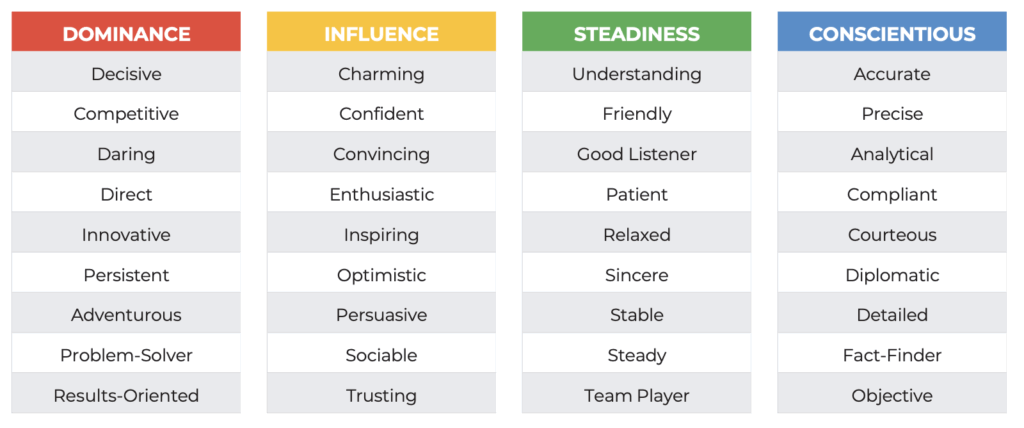
The DISC model is broken out into four main DISC types: Dominance, Influence, Steadiness, and Conscientiousness.
These four styles represent the core structure of the DISC model of behavior. Once you learn the four DISC profile types, you can see these styles represented in friends, colleagues, or even famous individuals you know from the government or TV.
However, each Style can be combined with an adjacent style to provide a deeper insight into an individual’s personality. A combination profile (i.e., SC-Style or DI-Style, etc.) blends the identifying features of each combined style into its own unique DISC Style. These blended profiles are no better than (or worse) than having a single, primary style like a D-Style or I-Style.
**A DISC assessment measures our perceptions that influence how we behave and act. When we understand behavior from this perspective, we can improve our self-awareness, communication, leadership, and more. DISC does not measure intelligence.
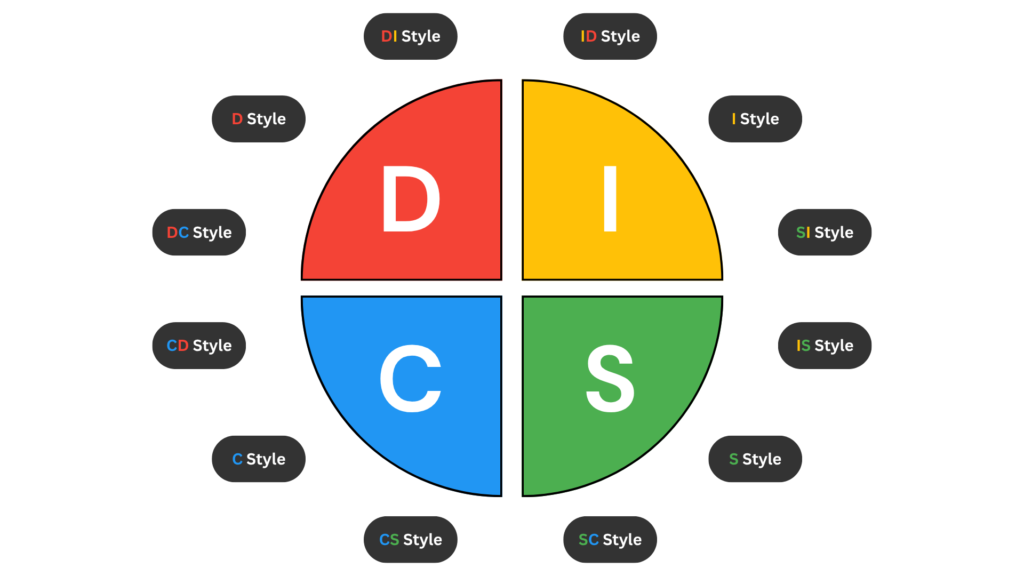
Someone with a flipped profile (like DI or ID-Style) has a unique style. Their general characteristics report (included in the Full DISC personality profile) will be similar but also differ in many ways.
The 12 unique DISC assessment types, or DISC styles, provide an essential perspective on how people differ in their motivations, fears, stressors, and communication.
In this article, we will explain how to identify and understand each of the 12 DISC personality types.
Managing a team and looking for help?
DISC will help you build a better culture and stronger, more productive teamwork. Read more about DISC for Teams or schedule a consultation with our team to get started.
DISC Personality Types Chart Comparison
The four DISC personality styles are very easy to understand and measure. The table below clearly shows key differences between each personality type.
However, what happens if someone is both Direct (D-Style) and Persuasive (I-Style) or Diplomatic (C-Style) and Patient (S-Style). These blended DISC styles create an additional 8 personality styles for a total of 12 unique styles.
Blended DISC Styles are no different than profiles that only have a single DISC style (however, blend profiles are more common DISC Styles to have). There are no bad or good DISC styles – each profile is unique to you and how you answer the assessment.
Is everyone a blend of all four DISC Styles?
Not everyone will receive a blended style report.
However, we all use the behaviors from each style. In fact, the creator of the DISC model, William Moulton Marston, used the Color Wheel to show how DISC can help you understand a person’s personality.
If someone had high Dominance, you would see more ‘Red’ on their color wheel. However, the red wouldn’t cover the other colors of their personality completely.

When you complete a DISC assessment, just because you don’t receive a particular style on your report, it doesn’t mean that behavior doesn’t show up in your personality.
Those behaviors may only show up under certain circumstances, whereas they appear more readily in others in many situations.
What DISC type is an introvert and extrovert?
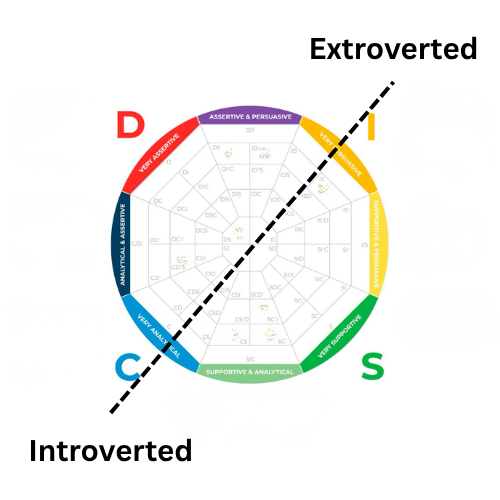
DISC assessment responses can be used to identify introverted and extroverted personality traits.
The I-Style is closely correlated with Extroversion.
The C-Style is closely correlated with Introversion.
The 12 DISC Personality Types
The 12 DISC Personality Types are presented to help you understand the similarities and differences between each category of style. We will highlight famous individuals DISC Style, highly correlated jobs, and more in each section!
The jobs and roles that correlate with each style are just that – correlations. DISC Basic doesn’t predict job performance, and it can still support the hiring process.
Wait.. Aren't there 16 Personality Types?
There are not 16 DISC Personality Types. There are only 12.
The ’16 Personalities’ are based on a different model called Myers-Briggs (MBTI). Read our comparison of these two tools here. Personality is difficult to measure, and each assessment offers a different point of view, like looking through multiple windows into a house. Each window offers its own perspective, which helps us better understand what’s going on inside.
D - Dominance
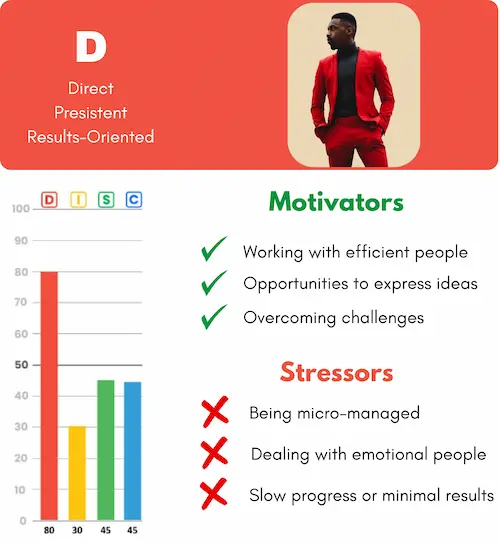
The Dominance (D personality type) is defined by decisiveness and competitiveness. People with this personality type are:
- Direct
- Results oriented
- Strong willed
This DISC assessment chart will show high Dominance scores.
People with this style likely seek control over situations and others. They are highly skeptical and fast-paced. They tend to be direct, if not blunt, with their opinions.
Highest Self-reported Jobs and Roles for this style:
- Executive
- Mid-Level Management
- Supervisory
- Warehouse / General Labor
Famous D-Personality Types:
- Angela Merkel
- Michael Jordan
- Gordon Ramsay
D Style Strengths
- They will turn decisions into action. They make things happen rather than discussing it.
D Style Challenges
- They can bulldoze past concerns by treating them as obstacles rather than useful information.
Having a productive work relationship with a D Style means..
- Giving them a clear outcome and room to determine how to get there.
DI - Dominance Influence
- The Dominance-Influence (DI personality type) is:
- Assertive
- Persuasive
- Results driven
When a person with this style has a great idea, they are likely to persuade everyone around them to take action. The DI personality type tends to be impatient and to view situations through a “win-lose” lens.
Highest Self-reported Jobs and Roles for this style:
- Executive
- Sales
- Skilled Trades
- Supervisory
Famous DI-Personality Types:
- Steve Jobs
- Madonna
- Tony Robbins
DI Style Strengths
- Quick to notice opportunities and figure out what to do next.
DI Style Challenges
- Might chase new opportunities instead of working through frustrations.
Having a productive work relationship with a DI Style means..
- Include them in decisions they can actually influence, set guardrails, and give them room to experiment.
DC — Dominance Conscientious
The blend of Dominance and Conscientious (DC Personality Type) produces a strong-willed personality. These individuals are
- Determined
- Excel at critical thinking
- Skeptical and Questioning
People with a DC personality type want to feel like experts in their field and fear failing to meet their own high standards.
Highest Self-reported Jobs and Roles for this style:
- Management Consultant
- Engineering Director
Famous DC-Personality Types:
- Barack Obama
- Condoleeza Rice
- Jeff Bezos
DC Style Strengths
- They can identify weaknesses and deal honestly with a problem.
DC Style Challenges
- They can become frustrated with poor logic, vague explanations, or inefficiencies.
Having a productive work relationship with a DC Style means..
- Showing them the reasoning instead of asking for blind trust.
I — Influence
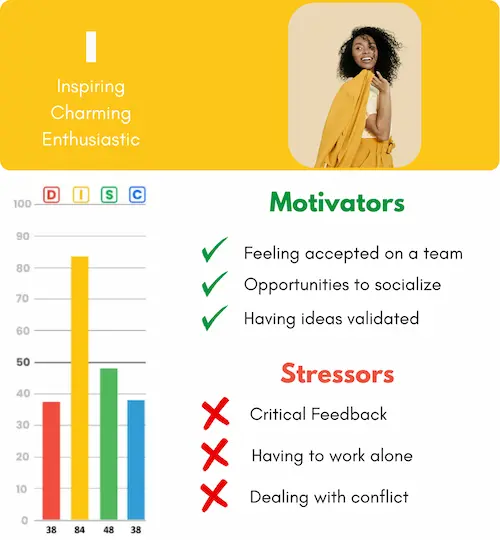
The Influence style (I personality type) is defined by
- Magnetism
- Collaboration
- Enthusiasm
People who rate high in Influence seek social recognition. They trust others quickly and come across as upbeat and energetic.
This DISC assessment chart will show high Influence scores.
Highest Self-reported Jobs and Roles for this style:
- Sales
- Teacher-Educator
Famous I-Personality Types:
- Dolly Parton
- Will Smith
- Robin Williams
I Style Strengths
- They will naturally notice the possibilities in uncertain times.
I Style Challenges
- They may avoid sitting with the negative and will look for the upside before they’ve dealt with something difficult in a change.
Having a productive work relationship with an I Style means..
- Give them something to look forward to. This style thrives on optimism.
ID — Influence Dominance
The Influence-Dominance (ID personality type) is similar to the DI-style, but instead of Dominance being the primary personality, Influence takes the lead.
ID people tend to be:
- Highly influential
- Upbeat
- Enthusiastic
Their biggest fear is being trapped in a fixed environment or losing the approval of others.
Highest Self-reported Jobs and Roles for this style:
- Sales Executive
- Supervisory
- Teacher / Educator
Famous ID-Personality Types:
- Richard Branson
- Oprah Winfrey
ID Style Strengths
- Keep people connected. They will naturally reach out, talk, and keep people engaged.
ID Style Challenges
- They may talk before they’ve fully processed everything, which means they may express reactions and possibilities in real time.
Having a productive work relationship with an ID Style means..
- Making communication a two-way street and keeping them connected during times of change.
IS — Influence Steadiness
The Influence-Steadiness style (IS personality type) is defined by high levels of empathy and a need to connect with others. People with this personality are:
- Welcoming
- Easygoing
- Trusting
On the other hand, they tend to take criticism personally and try to avoid conflict.
Highest Self-reported Jobs and Roles for this style:
- Customer Service
- Teacher Educator
- Health Care
Famous IS-Personality Types:
- Ellen DeGeneres
- Jimmy Fallon
- Fred Rogers (Mister Rogers)
IS Style Strengths
- When change brings stress or frustration, they naturally look for the good intentions underneath.
IS Style Challenges
- They may take on too much responsibility for how people feel and try too hard to keep everyone happy.
Having a productive work relationship with an IS Style means..
- Making sure they feel heard and included.
S — Steadiness
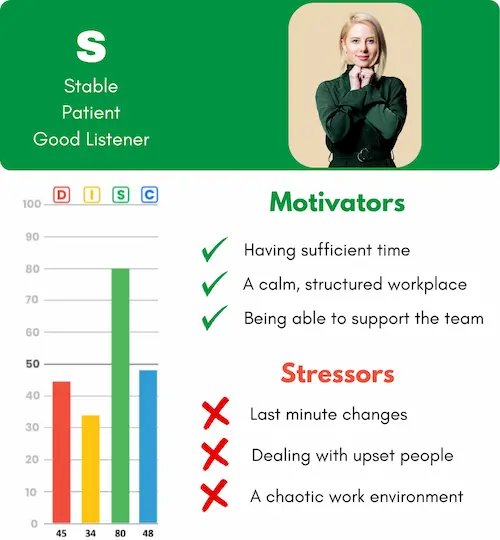
People with a primary Steadiness style (S personality Type) value:
- Consistency
- Harmony
They are likely to give others the benefit of the doubt and like to play a supportive role. If not careful, strong S personalities might have difficulty advocating for their own needs or retreat to more passive roles.
This DISC assessment chart will show high Steadiness scores.
Highest Self-reported Jobs and Roles for this style:
- Health Care
- Secretarial / Clerical
- Teacher Educator
Famous S-Personality Types:
- Mother Teresa
- Jimmy Stewart
- David Beckham
S Style Strengths
- They are comfortable moving forward with decisions, experimenting, and learning as they go.
S Style Challenges
- They may hold back concerns to avoid creating tension.
Having a productive work relationship with an S Style means..
- Giving them time to adjust instead of expecting an immediate switch after making a decision with them.
SI — Steadiness Influence
People with the Steadiness-Influence (SI) personality type are cheerleaders who want everyone to feel welcome. With a dominant S Personality type, SI people are:
- Conflict-averse
- Seek to serve others
They look for ways to bring people together and will prioritize the group over themselves.
Highest Self-reported Jobs and Roles for this style:
- Customer Service
- Teacher / Educator
- Health Care Worker
Famous SI-Personality Types:
- Bob Ross
- Michelle Obama
- Tom Hanks
SI Style Strengths
- They assume people are trying their best. When teams are stressed or frustrated, this style looks for good intentions underneath.
SI Style Challenges
- They may become so focused on how everyone else is doing that they carry emotions that aren’t theirs.
Having a productive work relationship with an SI Style means..
- Acknowledging the people issues and ensuring they are connected to the people they trust.
SC — Steadiness Conscientious
The Steadiness-Conscientious style (SC personality type) is characterized as:
- Risk aversion
- Modesty
SC people value stability and tend to be soft-spoken. They are highly reflective and cautious and prefer to work behind the scenes to make things happen.
Highest Self-reported Jobs and Roles for this style:
- IT
- Warehouse / General Labor
- Mechanical Technical
Famous SC-Personality Types:
- Sully Sullenberger
- Walter Cronkite
SC Style Strengths
- They look for what should be preserved rather than assuming everything needs to change.
SC Style Challenges
- They may put too much effort into preventing problems and forget they can handle them if they happen.
Having a productive work relationship with an SC Style means..
- Giving them time to think before expecting a commitment.
C — Conscientious
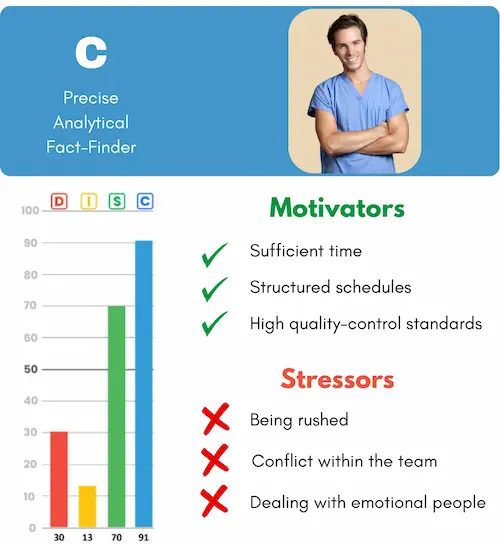
People who rate primarily as Conscientious (C personality Type) are:
- Methodical
- Precise
They tend to be great critical thinkers and highly value objectivity. They are determined to stick with a problem until it’s solved and excel at noticing small details.
This DISC assessment chart will show high Conscientious scores.
Highest Self-reported Jobs and Roles for this style:
- Assembly Worker
- IT
- Mechanical / Technical
Famous C-Personality Types:
- Bill Gates
- Albert Einstein
- Isaac Newton
C Style Strengths
- They bring clarity to complexity and break down complicated changes into parts so people can understand what they’re actually dealing with.
C Style Challenges
- They hold back until they’ve worked out a problem for themselves, resisting commitments until it makes personal sense.
Having a productive work relationship with a C Style means..
- Being clear about what we know and what we don’t. Showing the evidence behind important assumptions.
CD — Conscientious Dominance
The Conscientious-Dominance style (CD personality type) is all about using logic to control situations. People who rate as CD tend to overcome obstacles thanks to the high standards they hold for themselves — and others. People with this style seek:
- Strong resolutions
- Efficient results
Highest Self-reported Jobs and Roles for this style:
- IT Supervisor / Manager
- Engineer
Famous CD-Personality Types:
- Simon Cowell
- Kevin O’Leary
CD Style Strengths
- They look for weaknesses and challenge ideas so the team ends up with something stronger.
CD Style Challenges
- They can become overly critical and may focus so heavily on flaws that it becomes difficult to see what could work.
Having a productive work relationship with a CD Style means..
- Giving them influence over decisions that affect their work, and inviting them to challenge a plan before it’s finalized.
CS — Conscientious Steadiness
The last of the 12 DISC personality types is Conscientious Steadiness (CS Personality Type). The CS style sees two sides to every problem and value reliable outcomes. They are defined by:
- Having a high level of attention to detail
- Can sometimes err on the side of perfectionism.
They are careful and prepared for every situation.
Highest Self-reported Jobs and Roles for this style:
- Secretarial / Clerical
- Warehouse General / General Labor
- Mechanical / Technical
Famous CS-Personality Types:
- Warren Buffet
- Marie Curie
- Dr. Anthony Fauci
CS Style Strengths
- They bring order to uncertainty by gathering information, clarifying what is known, and creating a more solid path forward.
CS Style Challenges
- They may not feel confident moving forward with a decision or plan and keep preparing rather than taking action.
Having a productive work relationship with a CS Style means..
- Letting them test a new approach before fully committing and giving them information on what’s changing and why.
How to Read Your DISC Assessment Chart
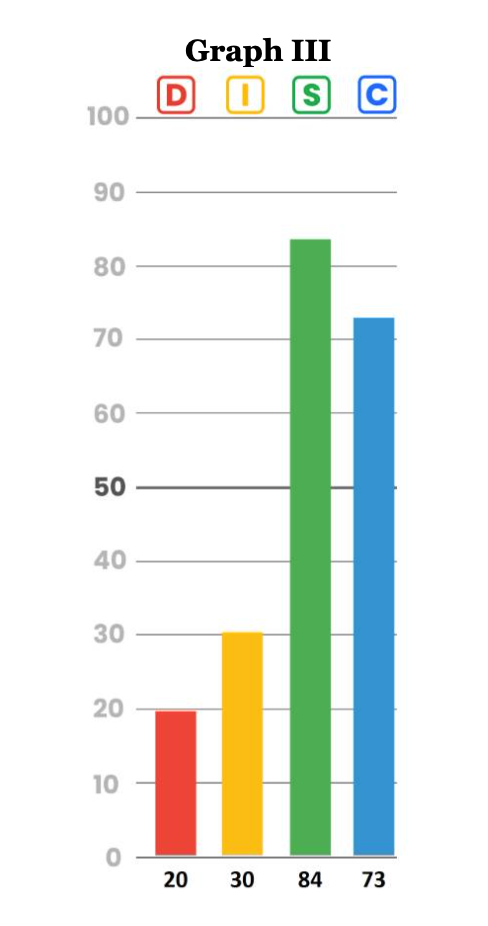
When you complete a DISC assessment, you will receive a chart that shows your DISC style along with a number score at the bottom of your graph for each primary style.
The higher your bar graph, the more inclined you are toward that particular style.
On this particular DISC assessment graph, you will see the following scores:
- D = 20
- I = 30
- S = 84
- C = 73
The cutoff for receiving a DISC letter is 50.
This person scored above 50 on both the S Personality Type and C Personality Type, and they received an SC Style. This style is the third most common DISC style.
DISC research shows that your DISC Style stays fairly consistent over your life. Research has found that DISC scores change slightly, but only moderately. When results do change, it’s due to major life events.
What does having a 'high' DISC style mean?
If you talk to someone who has used DISC for a long time, you might hear them say the phrase, “they have a high D style” or “they have a high S style”. This phrase comes from looking at the bar graph report and points out someone who has a single high bar graph compared to the other DISC bar graphs.
Learn your DISC Style
Whether you’re more of a DI or a CS, learning your DISC personality type can help you better navigate everyday situations. There is no “good” or “bad” type. This is a major point we make in our DISC Dos and Don’ts guide.
All 12 DISC personality types have their strengths and weaknesses, and understanding your personality type can be a significant first step toward growth and self-awareness.
As you’ve read through the 12 DISC personality types, you likely thought of people in your life — a boss, a friend, a family member — that fit one of these personality types. You may even see yourself in one or more of these types.
Do you want to know more about your DISC personality type? Complete a free DISC test, get a DISC Basic report, or explore in-depth options like DISC for leadership or DISC for teams. You’ll not only find out which of the 12 DISC styles you are, but also how that personality type informs your motivations and how you can better communicate with contrasting personality types.