
How does DISC compare to Myers-Briggs (MBTI)?

Adam Stamm
Managing Partner: Online DISC Profile
Adam was first certified in DISC in 2018. Over the years, he has developed new DISC Products and other personality-based tools. He is a Managing Partner at Online DISC Profile, Chapter President of the Association of Talent Development Greater Philadelphia Chapter, and lives in Philadelphia, PA (USA).
In 2009, I was first introduced to the Myers-Briggs self-assessment.
Truthfully, I was skeptical of the instrument because I was very familiar with DISC, yet I was surprised and delighted by how the Myers-Briggs assessment (specifically MBTI®) identified both how I saw myself and how others saw me in ways that differed from DISC.
In this article, I’ll share some key differences and similarities between what each model measures. This article won’t say which model is ‘best’. Instead, I will focus on where each tool provides value.
DISC Assessments vs Myers Briggs: The core differences
When comparing DISC assessments versus Myers-Briggs, it’s important to know that both DISC and Myers-Briggs Type Indicator (MBTI) measure aspects of our personality.
DISC measures how we show up in our behavior.
MBTI measures aspects of this and shows how we perceive the world around us.
| Feature | MBTI | DISC |
|---|---|---|
|
Focus |
Psychological Type: How you perceive the world and make decisions. |
Behavioral Style: How you respond to your environment and challenges. |
|
Primary Goal |
To explain why you think and process information the way you do. |
To predict how you will act and communicate with others. |
|
Flexibility |
Static: Generally viewed as your “born with” personality that stays consistent. |
Adaptive: Your style can shift depending on your job, stress levels, or social setting. |
|
Measurement |
16 distinct types based on 4 mental “dichotomies.” |
4 main quadrants (D, I, S, C) that blend into a spectrum to produce 12 behavioral styles. |
|
The “Asks” |
“Who am I at my core?” |
“How do I get things done and work with this team?” |
|
Origin |
Based on Jungian theory (Psychology). |
Based on the work of William Marston (Behavioral Science). |
|
Workplace Use |
Best for individual self-awareness and understanding personal “blind spots.” |
Best for team communication, sales training, and conflict resolution. |
What is the Myers-Briggs Type Indicator (MBTI)?
The Myers-Briggs Type Indicator (MBTI) is a self-report psychometric questionnaire designed to identify an individual’s psychological preferences in how they perceive the world and make decisions.
Developed by Katharine Cook Briggs and her daughter Isabel Briggs Myers, it is based on the conceptual theory proposed by Swiss psychiatrist Carl Jung. The goal of the indicator is to make the theory of psychological types understandable and useful in everyday life.
How It Works: The Four Scales
The MBTI classifies individuals into one of 16 personality types. Each type is represented by a four-letter code based on where you lean on four “dichotomies” (scales).
Think of these like being right-handed or left-handed: you can use both hands, but you have a natural, effortless preference for one.
| Scale | Preference | Description |
|---|---|---|
|
Energy |
Extraversion vs. Introversion |
Do you prefer to focus on the outer world (E) or your own inner world (I)? |
|
Information |
Sensing vs. iNtuition |
Do you prefer basic information as it comes in (S) or interpreting and adding meaning (N)? |
|
Decisions |
Thinking vs. Feeling |
Do you look at logic and consistency (T) or at the people and special circumstances (F)? |
|
Structure |
Judging vs. Perceiving |
Do you prefer to get things decided (J) or stay open to new information and options (P)? |
What is the DISC assessment?
DISC categorizes behavior into four primary styles. Most people are a blend of two or (sometimes, but rarely three), but usually have one “home base.” You can read about all 12 DISC Personality Styles here.
| Style | Descriptor | Focus |
|---|---|---|
|
Dominance |
Focuses on results, the “big picture,” and taking action. They are often direct and forceful. |
|
|
Influence |
Focuses on relationships, persuasion, and enthusiasm. They are often social and optimistic. |
|
|
Steadiness |
Focuses on cooperation, sincerity, and dependability. They are often calm and deliberate. |
|
|
Conscientiousness |
Focuses on quality, accuracy, and expertise. They are often analytical and systematic. |
Behavior in Environment
DISC focuses on outward behavior.
Observable Action: DISC measures how you “show up” in your environment. It asks: Is this person being active or reflective? Do they perceive their environment as friendly or challenging?
Adaptability: A core tenet of DISC is that, while you have a “Natural Style,” you can adjust your responses to the environment and stretch your behavior. We call this the Platinum Rule when thinking about adapting responses towards others.
DISC and Myers-Briggs (MBTI) Correlations
Both DISC and MBTI measure aspects of our personality.
As mentioned earlier, DISC measures our behavioral style (how we show up), and MBTI shows our perception of the world.
Put another way, the traits the MBTI measures influence how we behave (as measured by DISC).
Two overlapping areas of measurement are statistically correlated. Below, you can see how two areas from MBTI show up within the DISC model:
- Thinking – Feeling: Overlaps with DC/CD Style – IS/SI Style
- Extroverted – Introverted: Overlaps with C-Style and I-Style
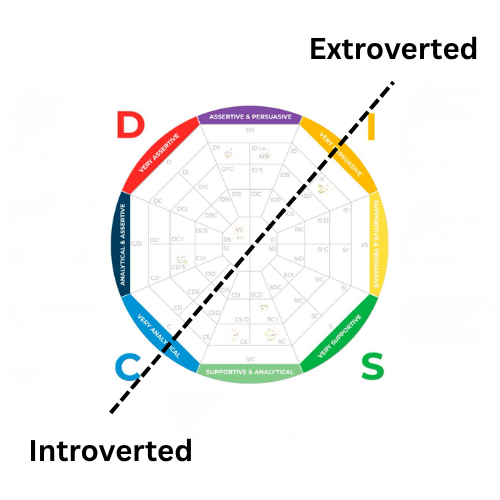
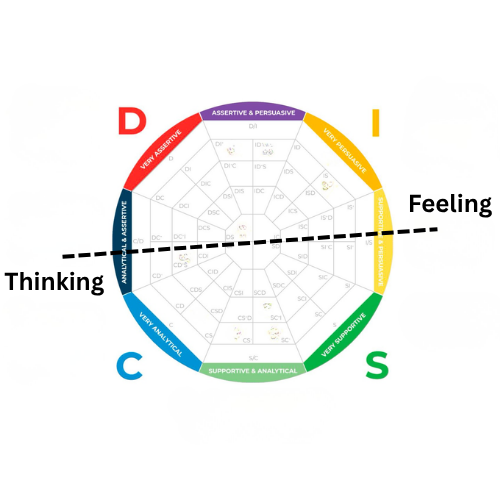
You can test these correlations yourself and see if they match your own DISC assessment results (or take DISC for free).
When I completed my own MBTI assessment, I received an ESFP type, which aligns with my SI style in the DISC model and shows that the mapped correlation above was spot on for my assessment results.
Below is a data table that shows how I showed up on both reports for three different areas and how they were similar in the profile generated based on my responses to the assessment.
| Core Area | MBTI Report (ESFP) | DISC Report (SI) | Comparison Summary |
|---|---|---|---|
|
Social & Team Dynamics |
Gregarious, exuberant, and an excellent team player. Enjoys working with others to make things happen. |
Thrives on collaboration, friendly cooperation, and generating enthusiasm. Wants everyone to feel included. |
High Similarity: Both profiles strongly highlight my people-first approach and natural ability to rally a team. |
|
Empathy & Support |
Warm, accepting, and ready to show compassion. Driven by a strong desire to meet others’ needs. |
Sympathetic, warm, and focused on meeting people’s practical needs in creative ways. |
High Similarity: Giving support and being approachable is a foundational motivator across both assessments. |
|
Conflict & Harmony |
Plays the peacemaker but tends to keep a low profile. Can gloss over problems or sweep them under the rug to maintain peace. |
Natural peacemaker. Excellent at easing tense situations and pulling conflicting factions together. |
Identical Intent, Different Execution: Both label me a “peacemaker”. However, DiSC warns that I might avoid problems to my own detriment, while MBTI focuses on my active ability to diffuse tension. |
Reliability and validity
In psychometrics, reliability is about consistency (does the test give the same result over time?), while validity is about accuracy (does it measure what it claims to measure?).
Based on the official Myers-Briggs Foundation and technical research reports on the DISC profile, here is how the two compare.
Reliability (Consistency)
Reliability is often measured using Cronbach’s Alpha, where scores above 0.70 are considered “acceptable” and above 0.80 are “very good”.
| Assessment | Reliability Findings |
|---|---|
|
MBTI |
The Myers-Briggs Company reports that all four scales have internal consistency of 0.90 or greater for Form M. Research meta-analyses generally place reliability between 0.80 and 0.87. |
|
DISC |
DISC profile shows a composite mean of 0.84. Specifically: Dominance (0.88), Influencing (0.75), Steadiness (0.87), and Conscientiousness (0.86). |
What this means: both instruments meet or exceed high psychometric standards for reliability, meaning they are consistent and not “random”.
Validity (Accuracy)
Validity asks: “Does the measure behave the way the theory says it should?”.
MBTI Validity
The Myers-Briggs Foundation argues for experiential and construct validity.
Theory Support: Studies show that types behave predictably. For example, Introverts spend more time in “heads down” work, while Intuitives show higher interest in artistic occupations.
The “Type” Debate: Critics point out that most people actually fall in the middle of a bell curve rather than being “pure” types, but MBTI theorists argue that the preference remains valid even if the behavior is flexible.
DISC Validity
The DISC Research report focuses on Construct Validity through correlations between opposite styles.
Opposite Scales: The model proposes that “opposite” traits should have strong negative correlations (e.g., if you are high in D, you should be lower in S).
Findings: The data support this, showing strong negative correlations between Influencing & Conscientious (-0.57) and between Dominance & Steadiness (-0.55).
Important Scientific Caveats
Both models acknowledge certain limitations:
Self-Reporting: Both depend entirely on the honesty and self-awareness of the person taking them.
Mindset Matters: Your results can shift if you are taking the test while “faking” a persona (like a “work-self” vs. your “true-self”).
Ipsative Design: Most psychometric tools (including these) measure qualities as individuals perceive them relative to other traits, not as absolute physical quantities like blood pressure.
Summary Table of Certifications
| Measure | MBTI | DISC |
|---|---|---|
|
Standards |
APA, AERA, and NCME guidelines |
APA, AERA, and NCME guidelines |
|
Certification |
Peer-reviewed over 70+ years |
When to use each assessment
Both DISC and MBTI offer specific insights for self-awareness and personal development. Below are my perspectives on when you can best use either tool:
What to Use MBTI for:
MBTI is best suited for long-term personal development and deep self-awareness. Because it focuses on internal preferences—how you process information and recharge—it is most effective for:
- Individual Self-Discovery: Helping people understand their “mental wiring” and why they feel drained by certain environments. Example from my own MBTI Profile: As an ESFP, I realize I feel exhausted in data-heavy roles because my “Sensing” preference craves variety over abstract numbers.
- Career Coaching: Identifying paths that align with natural psychological comfort zones. Example: A student using their “Feeling” preference to choose a path in Social Work rather than Engineering.
What to Use DISC for:
DISC is widely considered the practical workplace choice because it’s easier to understand and use throughout the workday.
- Team Communication & Sales: Learning how to “read” others quickly and adapt your style to match theirs. Example: An “SI-Style” salesperson noticing a client is a “High D” and intentionally being more direct and brief to close the deal.
- Onboarding and Management: Providing managers with a “manual” on how to motivate and delegate to a new hire. Example: A manager seeing a new hire is a “High S” and ensuring they provide clear, stable instructions rather than vague, last-minute changes.
Learn more about DISC for Teams and how to use DISC for onboarding.
When to Use Both Together
Using MBTI and DISC together provides a 3D view of a person: MBTI provides the “Roots” (who they are), and DISC provides the “Fruits” (how they act).
How to implement both:
- The “Internal/External” Workshop: Use MBTI in the morning to help team members understand their own values and energy. Use DISC in the afternoon to practice speaking to one another based on those types.
- Executive Coaching: A coach might use MBTI to help an executive find more meaning in their work while using DISC to help that same executive stop intimidating their staff with “High D” behaviors. Mostly kidding.
Choosing the right tool for your team
Are you interested in learning more about DISC compared to other Workplace / Corporate assessments? Read our article comparing DISC to Gallup’s StrengthsFinder assessment.
Are you looking for support in getting started with DISC?
Fill out the form below to let us know more about your team and your goals for using DISC. A member of our team will be in touch soon!
"*" indicates required fields