How does DISC compare to Gallup’s CliftonStrengths

Adam Stamm
Managing Partner: Online DISC Profile
Adam was first certified in DISC in 2018. Over the years, he has developed new DISC Products and other personality-based tools. He is a Managing Partner at Online DISC Profile, Chapter President of the Association of Talent Development Greater Philadelphia Chapter, and lives in Philadelphia, PA (USA).
CliftonStrengths and DISC are both self-awareness tools that are designed to improve self-awareness. Each tool operates through slightly different lenses. CliftonStrengths focuses on what you are naturally good at (internal talents), while DISC focuses on how you interact and communicate with others.
Both tools provide value. This comparison report will help highlight the best use cases for each, and not determine which tool is ‘best’. The journey towards self-development and awareness can be long and difficult, and we need as many guides as possible to help us navigate it.
The core differences at a glance
DISC and CliftonStrengths are prominent psychometric tools used in organizational development. However, they have differences in what they measured and how they are primarily used:
| Feature | CliftonStrengths | DISC |
|---|---|---|
|
Primary Definition |
Measures innate talents—naturally recurring patterns of thought, feeling, or behavior that can be developed into strengths. |
Measures behavioral style and preferences based on four quadrants: Dominance, Influence, Steadiness, and Conscientiousness. |
|
Core Framework |
Identifies a unique rank order of 34 talent themes categorized into four domains: Executing, Influencing, Relationship Building, and Strategic Thinking. |
Utilizes a bar-graph model with two dimensions: Fast-Paced/Outspoken vs. Cautious/Reflective and Questioning/Skeptical vs. Accepting/Warm. |
|
Methodology |
Polytomous multidimensional forced-choice format. Users choose between paired self-descriptors within 20-second time limits. |
4-Dimensional Ipsative Design: Dominance, Influencing, Steadiness, and Conscientiousness. |
|
Complexity |
Extremely high: There are over 33 million possible permutations of an individual’s top five themes. |
Moderate: Focuses on 12 primary styles (e.g., DI, IS, CD) derived from the four main quadrants to ensure results are memorable and actionable. |
|
Key Application |
Personalized Development: Focusing on individual excellence, career pathing, and maximizing one’s “Signature Themes.” |
Relationship Management: Improving team communication, managing conflict, and adapting one’s style to connect and communicate better with colleagues. |
What is Gallup's CliftonStrengths?
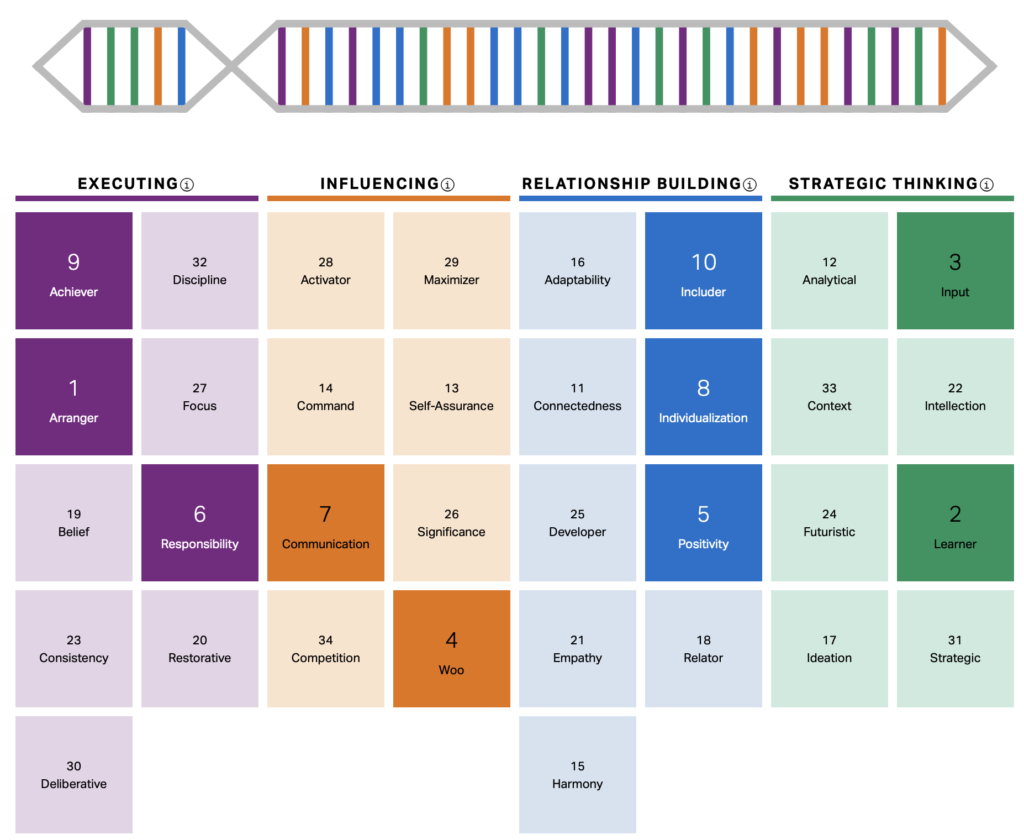
CliftonStrengths is a psychometric assessment designed to identify an individual’s greatest potential for developing strengths.
The assessment was originally called StrengthsFinder and was released in 1999. It’s possible you will hear the tool referred to by a few different names (CliftonStrengths, StrengthsFinder, StrengthsFinder 2.0, and StrengthsQuest).
The tool gained widespread popularity from the bestselling book titled StrengthsFinder 2.0 by Tom Rath. In the book, Rath argues you should stop trying to fix your weaknesses and start building on what you naturally do best.
How It Works: Talents into Strengths
The core philosophy is that people achieve far more by building on their natural talents than by expending equal energy trying to fix their deficiencies. The assessment works through the following logic:
- Identify Talent: Talent is a naturally recurring pattern that cannot be readily acquired; it is innate potential.
- Ranking Themes: The assessment measures the intensity of 34 talent themes. Respondents receive a ranked profile that focuses on their Top Five talents.
- Seeking Multiplier Effect: The tool defines strength as the ability to provide “consistent, near-perfect performance” in a specific task. This is achieved by investing time, skills, and knowledge into a natural talent (Talent x Investment = Strength)
How it works: My Strengths Profile
The Gallup StrengthsFinder report I shared above can be a little overwhelming if you don’t know what you are looking at.
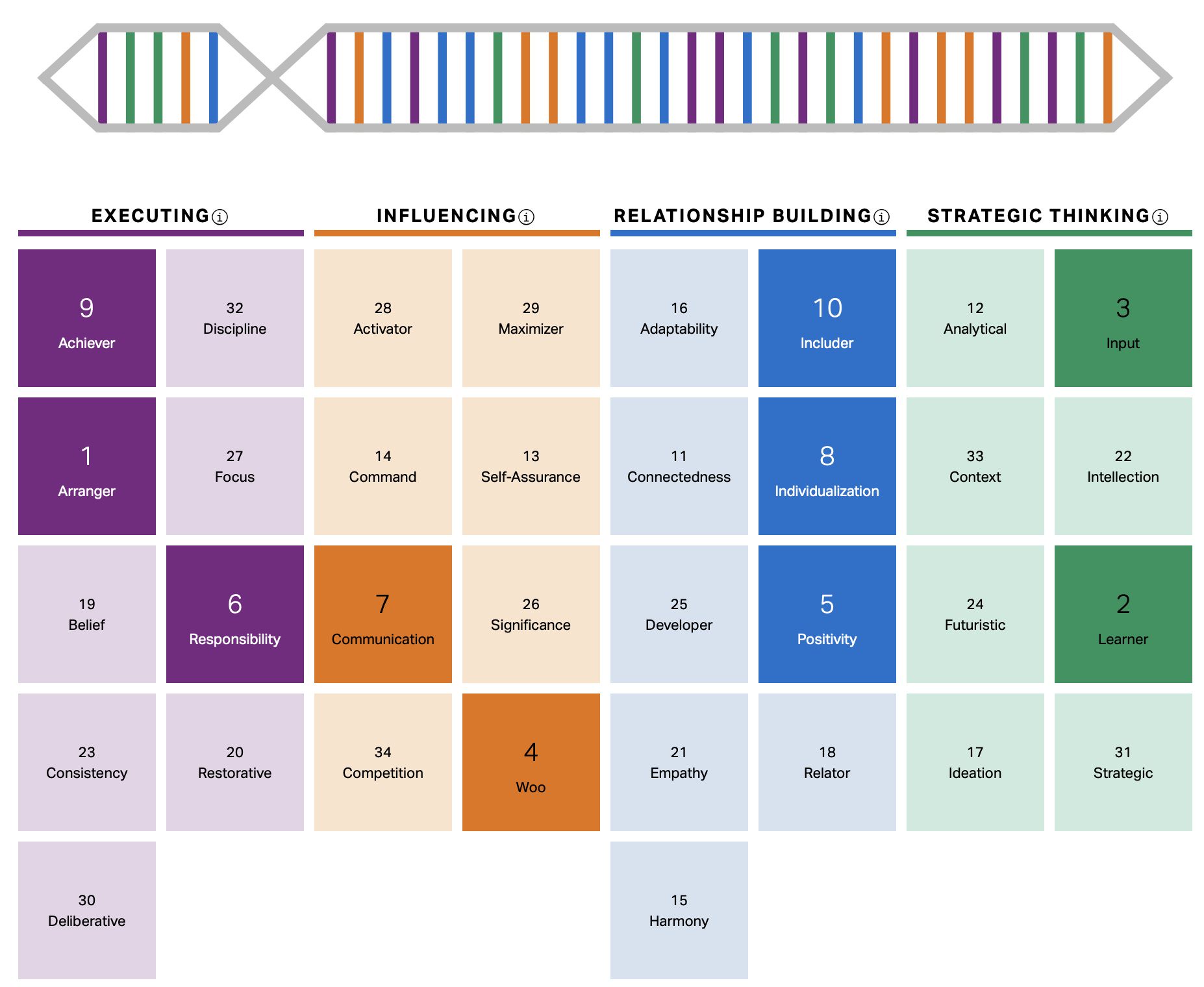
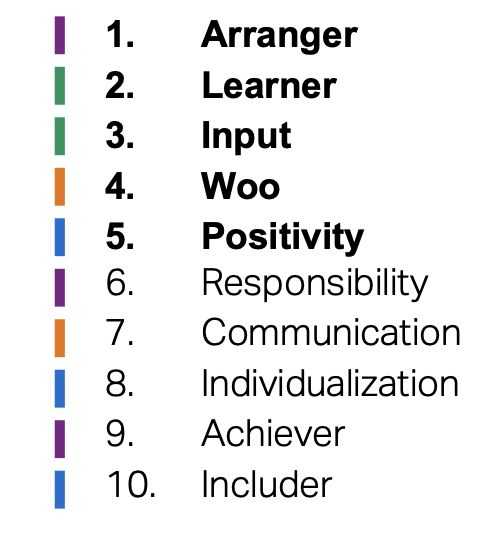
Fortunately, the report lists your top 10 strengths and highlights the top 5 so you can focus on those key areas.
You can see that the assessment has identified my top 10 strengths and ranked them.
My goal now is to find ways to perform in areas where I can use my strengths. As one example, my top strength, Arranger, is often engaged as I work with my team to manage this and other businesses we own.
I frequently will engage in my second strength, Learner, to support my growth as an Arranger. I spent 4 years volunteering on the Board of Directors of the Greater Philadelphia Chapter of the Association for Talent Development.
Limitations and Challenges
CliftonStrengths is a powerful developmental tool. Like all models and tools, it has specific constraints and implementation challenges.
- Quality of Results: One of the assessment features (timed responses) requires a respondent to focus. If this requirement is not met, it can reduce the quality of the findings.
- Interpersonal Friction: The instrument provides a shared language for teams. However, with many markedly different strengths, it’s possible teams will still find it difficult to understand each person’s instinctive approach.
- Not for Selection: Clifton Strengths is designed exclusively for personal development and self-awareness. It is not a tool for predictive measurement or employee selection.
What is the DISC Assessment?
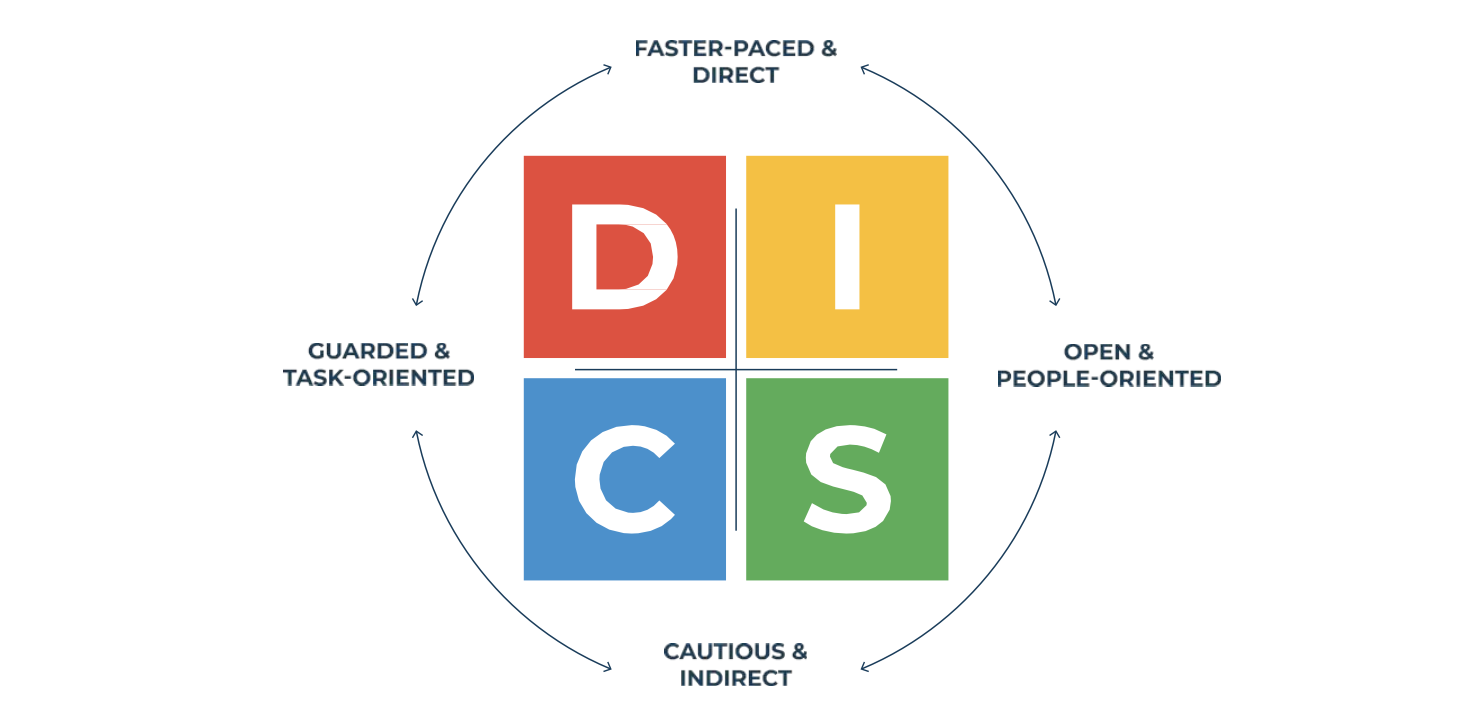
DISC is a personal development tool that measures a person’s behavioral preferences and tendencies. The model describes four basic styles: Dominance (D), Influence (I), Steadiness (S), and Conscientiousness (C). The tool aims to help individuals understand themselves and interact more effectively with others.
How It Works: Visualizing Behaviors
DISC is defined by two primary dimensions of human behavior, which translate into four main styles.
- Vertical Dimension (Pace): Measures if a person is fast-paced and direct (active, assertive, bold) or cautious and indirect (moderate-paced, calm, methodical).
- Horizontal Dimension (Agreeableness): Measures whether a person is Guarded & Task-Oriented (logic-focused, objecting, challenging) or Open & People-Oriented (Accepting, empathizing, receptive).
- The Platinum Rule & The Idea of Stretch: A primary lesson from DISC is teaching how to stretch and use other behaviors to help interpersonal interactions. It uses the Platinum Rule: Treat others as they wish to be treated.
Limitations and Restrictions
DISC is a powerful tool for understanding motivations, stressors, and relationship conflict. However, it does have limitations:
- Measurement Error: Like all psychometric instruments, DISC is subject to random variation and error; it provides a measure of degree rather than an absolute binary classification.
- Feels Simplistic: One of DISC’s greatest strengths is also its greatest weakness: model simplicity. Participants might feel ‘boxed in’ if their behavioral profile is limited by a four-letter result.
- Magic Bullet Belief: Relationships are complex. Teams might use DISC with the belief that if they can just label behavior, conflict will vanish. This belief can hurt team building and cause conflicts to grow.
Reliability and validity
Understanding the accuracy and reliability of CliftonStrengths and DISC requires examining psychometric stability (will you get the same results twice?) and contextual suitability (when should you avoid using them?).
Both tools are considered “high-quality” in the industry but are subject to random measurement errors—such as a user’s fatigue, distractions, or current emotional state—which can lead to fluctuations in results.
Test-Retest Reliability: Will results change?
Reliability measures how consistently a tool produces the same results over time. Generally, both assessments show strong stability, but shifts do occur.
Both tools used a Statistical method called Cronbach’s alpha, which is computed by correlating each item’s score with the total score for each measurement. This measurement is used to determine both the reliability (is it measuring what it seeks to measure) and validity (is it accurate) of the tool
| Factor | CliftonStrengths | DISC |
|---|---|---|
|
Reliability Measurement |
0.73 (Full Profile) over 6 months. |
Range from 0.75 (Influencing) to 0.88 (Dominance) |
|
Test-Retest Stability |
0.73 over a 6-month interval |
Composite mean of 0.84 |
While both assessments are designed to measure stable traits, it is normal to see minor shifts if you retake them.
Reasons results might shift:
Developmental Maturity: Younger respondents (under 24) often see more change as they transition from school to a professional career and may interpret questions differently as they gain more life experience.
Significant Life Events: Major life-altering events or traumatic changes can shift how you engage with the world, leading to a new perspective on the assessment’s paired statements.
Initial Testing Conditions: If a user was rushed, distracted, or didn’t take the first attempt seriously, a retake often produces a “clearer” result that more accurately reflects their true talents.
Self-Reporting Bias: Both assessments are ‘self-assessments’. Answering based on who you want to be rather than who you are can lead to fluctuating or “skewed” results.
When to use each assessment
Deciding when to use DISC and CliftonStrengths depends on what you are looking to understand. CliftonStrengths looks at individual potential, whereas DISC seeks to understand interpersonal dynamics.
Use CliftonStrengths for:
CliftonStrengths is best for long-term personal development and identifying how an individual can uniquely contribute to a team’s success.
Individual Excellence and Role Fit: Identifying the natural talents an individual should lean into for maximum productivity.
Example: I (Adam Stamm) scored high for Achiever (you can see my full results here). I have found I am best suited for roles where success is measurable and accomplishments are frequent.
Performance and Engagement: Increasing satisfaction by ensuring people are doing work that aligns with their natural thinking and behavior patterns.
Example: Gallup has measured employee engagement levels for decades, and StrengthsFinder is extremely helpful in understanding the tasks that cause disengagement. Using my own StrengthsFinder results, I’ve learned that repetitive tasks drain my energy.
Use DISC for:
DISC is the ideal tool for improving immediate team communication, managing conflict, and adapting one’s behavior to specific workplace scenarios.
- Conflict Resolution: De-escalating friction by recognizing that “difficult” behaviors are often just different behavioral priorities.
Example: We are often contracted to coach leaders. The number one issue we discuss in these coaching sessions is that certain DISC Styles often conflict due to competing priorities. When the conflict is reframed in this manner, tensions lower and dialogue resumes.
- Improving Team Synergy: Helping coworkers understand each other’s “internal motor” (pace) and external focus (tasks vs. people).
Example: Years ago, we worked with a team of engineers. The team was struggling to complete projects on time, and a leader was shifted from another department to help. Almost immediately, complaints were made to HR about the new leader. The group’s Team Dynamics report was monumental in showing why: the new team leader was focused on results, whereas the team was focused on analysis.
Can you use both together?
Yes.
Using both tools provides a “fuller picture” of what makes us tick. CliftonStrengths explains what tools a person has in their internal toolkit, while DISC explains how they choose to use them when interacting with others.
Real-World Use Examples:
The Effective Meeting: A team uses DISC to set the “ground rules” for a meeting (e.g., “D” styles agree to listen first; “i” styles agree to keep it brief). They then use CliftonStrengths to assign specific project tasks (e.g., the person with “Focus” creates the timeline, while the “Ideation” person brainstorms solutions).
Onboarding New Hires: Have new hires take both assessments. The manager uses DISC to understand how to communicate feedback most effectively (e.g., a “C” style hire wants feedback in writing and with data). Simultaneously, the manager uses CliftonStrengths to assign their first “stretch” project aligned with their natural talents, such as “Strategic” or “Command”.
Choosing the right tool for your team
By now, hopefully, I’ve made a case that:
- Both Strengths and DISC are valid and reliable tools that will show what someone enjoys and how they will do it.
- These tools can be used together or on their own. They are both useful guides during the personal and professional development journey.
- CliftonStrengths is most helpful for role alignment and for understanding work engagement.
- DISC is most helpful for understanding interpersonal relationships and team dynamics.
If you are interested in learning more about how tools like DISC compare to other workplace / corporate assessments, please read our article comparing DISC to Myers-Briggs (MBTI).
Are you looking to start using DISC? We would love a chance to work with you. Connect with someone on our team by filling out the form below.
"*" indicates required fields