
Workplace attitudes – are there more workaholics or clock-watchers?

Adam Stamm
Managing Partner: Online DISC Profile
Adam was first certified in DISC in 2018. Over the years, he has developed new DISC Products and other personality-based tools. He is a Managing Partner at Online DISC Profile, Chapter President of the Association of Talent Development Greater Philadelphia Chapter, and lives in Philadelphia, PA (USA).
Whether you work in retail, hospitality, or a typical 9-5 office job, each person will view the working day with a different attitude and come with a perceived workplace “trope”.
And these exist all around the world.
We’ve surveyed over 1,300 people globally to get their opinions on the working day, with additional research into typical workplace tropes and how these differ across the world, including certain countries’ attitudes towards the working day.
Exploring the insights, I share how these workplace attitudes can correlate with your DISC personality type and speak to HR expert Michele Haugh, who has decades of HR experience across corporate and consulting roles, to understand how workplace attitudes differ globally, and what businesses need to do to manage culturally diverse teams.

What are employees' attitudes towards work?
We asked 1,339 people worldwide about their attitudes towards work, whether they believe it should come first, or prioritize a better work-life balance.
Key stats
- 38% of people are very likely or likely to believe that work should come first
- Well over half (60%) of people surveyed are very likely or likely to work late (unpaid)
- This compares to just under half (49%) who would finish work in the allotted time, and allotted time only
- The majority of people (79%) are very likely or likely to speak up at work when they think something could be done better
- An overwhelming 82% are very likely or likely to strive towards perfection at work
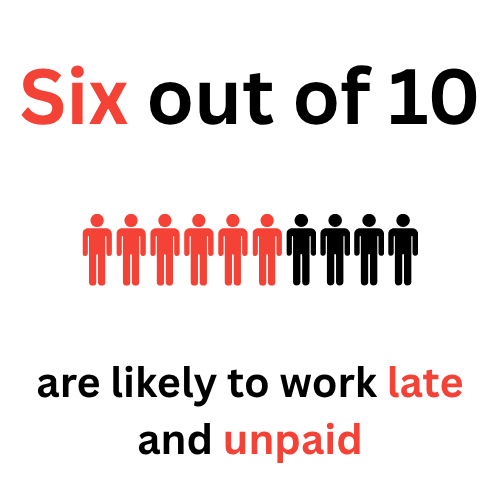
Despite many people surveyed saying they believe work should come first, nearly half (48%) would be very likely or likely to leave a job if the work-life balance wasn’t fair.
Perhaps this shows that despite feeling like work is the priority, it is only when the work-life balance is also fair. So employees are prioritizing work and working hard, but might not be very happy about working extra overtime.
Attitudes in the US
According to our survey findings, the attitudes of employees in the United States suggest that a lot of people reflect the “workaholic” trope. More than half (58%) are likely or very likely to work late (and do so unpaid).
64% of our survey respondents are based in the US. Looking at data for the ten states with the highest respondent count, we found:
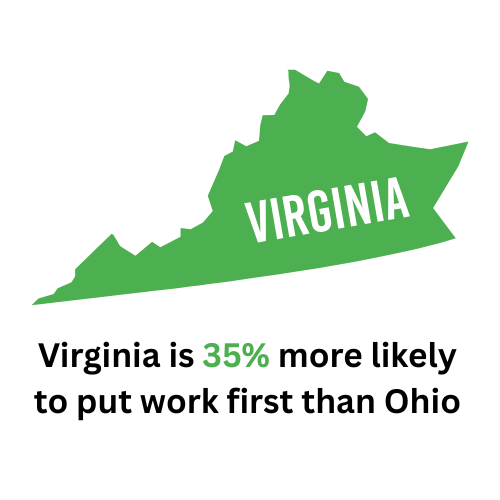
- Virginia is 35% more likely to put work first than Ohio
- California is 14% more likely to stay and work late (often unpaid) than Texas
- Florida is 12% more likely to strive towards perfection at work than New York
- Texas is 17% more likely to finish work at the allotted time (and allotted time only) than Virginia
When it comes to working late, California is also slightly higher (86%) than the US respondent average (82%).
Some of the common workplace attitudes and tropes from around the world

Before we dive into workplace attitudes around the world, it is important to highlight that while specific workplace tropes exist, and cultural impact can play a part, these can be harmful, and stereotypes should be avoided.
Some of the most common tropes are:
| Trope | Motivation | Motto |
|---|---|---|
|
Workaholic |
Compulsion/Anxiety |
“I’ll sleep when I’m dead.” |
|
Clock-watcher |
Work-Life Balance |
“You get what you pay for.” |
|
The perfectionist |
Fear of Failure |
“If it’s not perfect, it’s wrong.” |
|
The coaster |
Comfort |
“Don’t rock the boat.” |
|
The gunner |
Status/Power |
“Second place is the first loser.” |
Results from our survey
A smaller number (36%) of respondents in the survey were from outside of the US, from places all around the globe.
The number of respondents varied across countries, and we have examined the top five countries by respondent count.
Compared with the US average, the Philippines is more likely (4%) to strike for perfection, to work their allotted time (25%), and to put work first (15%).
When it comes to working extra hours, Canada comes in slightly above the US average, at 2% higher.
And interestingly, the United Kingdom is 32% less likely to work their allotted time than the US, though a quarter are less likely to put work first.
Other key stats include:
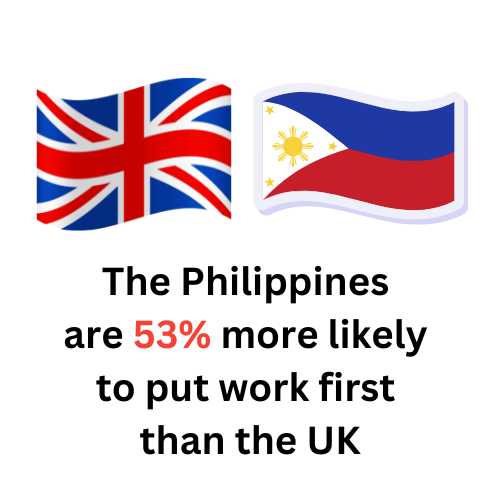
- The Philippines are 53% more likely to put work first than the UK
- Interestingly, though, the UK is then 20% more likely to stay late (often unpaid) than the Philippines
- This then makes sense as the Philippines is also 84% more likely to only work their allotted time, suggesting that whilst the Philippines is likely to put work first, they do it without having to work overtime, something the UK does more often
- The Philippines is also the most likely out of the five countries we looked at to strive towards perfection, being 6% more likely than Canada, which sits at the bottom
- The United Kingdom is 32% less likely than the US to work only the allotted time, and a quarter are less likely to put work first.
Common country-specific workplace tropes
Japan
One of the workplace tropes evident in Japanese culture is the workaholic.
A survey on workaholism around the world found that it’s rather common for Japanese workers to feel guilty about taking vacation time, with only 52% of the participants agreeing that a work-life balance is essential.
There is even a Japanese term for being overworked: ‘karoshi’. It quite literally means ‘death by overwork’, and has been around for decades.
Japan is known for having a big respect for hierarchy, punctuality, long working hours, and group-oriented decision-making.
United States
In a study of work-life balance from Remitly, the US ranks 19th out of 22, also working the longest day at 8 hours and 29 minutes.
This study also found, however, that the US has one of the shortest commute times to work, averaging at 40 minutes.
Additional statistics show that 77% of Americans who work full-time have experienced burnout at their jobs, with the country ranking high for workaholism.
Finland
Finland consistently ranks very highly for work-life balance, regularly topping the list of the world’s happiest countries. 2026 is its ninth year in a row in the top spot.
In the same work-life balance study by Remitly, Finland has the best balance, scoring 73 out of 100 on their index. Another work-life balance study ranked Finland 9th.
New Zealand
In the Global Life-Work Balance Index 2025 study from Remote, New Zealand ranks number one.
The study examined statutory days of annual leave, maternity leave, and the minimum wage, among other factors, and ranked New Zealand 86.95 out of 100.
In a similar study by Remitly, New Zealand ranks fifth.
Other workplace statistics
- Almost one-third (30%) of working individuals worldwide plan to emigrate in the next five years for a better quality of work life.
- Workers in the USA, Brazil, Australia, and Ireland work the longest average working days, working longer than the OECD average of 36 hours a week.
- Chinese workers are generally expected to work from 9 am to 9 pm, six days a week.
In a survey on what the world thinks about work, the Philippines ranked number one (at 99%) when asked how important work is, and whether it should always come first.
Work-life balance - where does your country rank?
| Rank | Country | 2026 Avg ranking | Remote ranking | Remitly ranking |
|---|---|---|---|---|
|
1 |
New Zealand |
73.30 |
60 |
86.59 |
|
2 |
Finland |
72.21 |
73 |
71.42 |
|
3 |
Denmark |
71.88 |
70 |
73.76 |
|
4 |
Belgium |
64.96 |
54 |
75.91 |
|
5 |
France |
64.81 |
62 |
67.62 |
|
6 |
Germany |
63.19 |
52 |
74.37 |
|
7 |
Netherlands |
62.91 |
56 |
69.82 |
|
8 |
Switzerland |
62.24 |
65 |
59.47 |
|
9 |
Portugal |
61.89 |
54 |
69.78 |
|
10 |
Spain |
61.27 |
52 |
70.53 |
Understanding workplace attitudes and personalities
The average workplace likely has all five of our featured “workplace tropes” at play, and businesses need to be able to identify them in people and manage the differences effectively.
Someone from Finland, for example, might have a more relaxed attitude towards work and favor a better work-life balance than perhaps someone from the US. But if they work for a global business based in the US, managers should acknowledge the difference and perhaps offer more flexible working hours to better accommodate the work-life balance they are used to.
While it is not evident that DISC personality types have a direct correlation with typical workplace tropes, each style has a measurable psychological need that could cause them to fall into the DISC categories, and can help leaders to manage the differences.
This style has a strong need for control, and it’s very possible that this drive could lead them towards being a “workaholic” or a “gunner.”
However, this connection really depends on how aligned they are in overcoming challenges (a shared trait of both the D and C Personality). Those who are energized by overcoming challenges and have a high need for control likely would fit these two work tropes.
This style has a strong need for acceptance and recognition. In my experience, this personality type could fall into either the “perfectionist” or the “coaster” tropes.
The ‘I’ in I-Personality stands for “Influence”, and in Marston’s original 1928 description of these styles, he describes this style as someone who could move planets with their influence. This style could easily lean on their ability to influence others and coast along, believing they can smooth anything over without repercussions. The opposite is also true; in an effort to feel accepted and gain recognition, they may be moved towards perfectionism.
This style has a strong need for stability, and so it’s possible they may fall into “workaholic” mode because they want to maintain a level of stability (economic or psychological).
It’s also possible that they may be viewed as a “clock-watcher” due to their systematic thinking. Those with the S-Style prefer to work within systems (it feeds into their need for stability and predictability). It’s possible that others may think of them as “clock-watchers” when in reality they see themselves as following the rules.
This style has a strong need for accuracy, so they may become “perfectionists”.
Those who have this style want to know all of the details and ensure that whatever they are building or creating works exactly as planned. This could easily cause them to slip into ‘perfection’ mode rather than ‘get it done’ mode. Like the S-Style, this personality type prefers working within predictable systems. It’s possible that they may be viewed as a “clock-watcher” when in reality they see themselves as following a shared set of rules
Communication is a must
Workplace tropes, by themselves, can be harmful labels, but pairing this awareness with knowledge of DISC can open up rewarding, insightful conversations.
Instead of just labeling someone a ‘workaholic’ or a ‘perfectionist,’ you can approach them and start a transparent, open conversation around what you are witnessing.
The conversation could go like this: “I’ve noticed you’ve been working a lot recently. Is there anything going on? I know you have a strong D-Style, and I was wondering if you might feel like we aren’t getting the results you expected?” This type of conversation has a subtle change in its approach. It’s not just looking at a person’s behavior that can elicit a strong response. Instead, it asks about a person’s motivation, which is more open-ended and requests a person to be more introspective rather than defensive about what they are doing.
The majority of people (79%) surveyed would speak up at work when they think something could be done, and understanding a person’s communication styles can help this conversation go well.
“Workplace tropes, by themselves, can be harmful labels, but coupling this awareness with a knowledge of DISC can open up conversations that are rewarding and insightful.”
Adam Stamm
As an example, if you are working with a high I personality type, bringing enthusiasm to how you talk to them can be a much more effective way to communicate.
Global businesses need to understand their culturally diverse teams
Businesses can have employees from across the globe and a variety of cultural backgrounds, even if the business isn’t global.
Michele Haugh, from EarlyHR Solutions and EarlyEngage, says that cultural awareness isn’t something that just exists; it has to be taught, modeled, and talked about consistently.
She says, “When leaders begin learning about the cultural rhythms that matter to their employees, it changes how they lead. It shifts conversations from assumptions to curiosity. Something as simple as acknowledging a holiday, offering schedule flexibility, or asking someone how they celebrate an important day sends a powerful signal of respect.
“Global leadership requires humility. It requires leaders to replace assumptions with learning and to create an environment where cultural differences are recognized rather than ignored.”
As we have found in our research, cultural attitudes towards work-life balance and general workplace practices can differ greatly. Michele notes that performance metrics and “success” should be redefined to focus on the outcomes
“Global leadership requires humility. It requires leaders to replace assumptions with learning and to create an environment where cultural differences are recognized rather than ignored.”
Michele Haugh
She says: “Success, for example, should be defined by deliverables and results, quality of work, collaboration and contribution, and impact on the organization. How this is achieved may look different across cultures, so it is imperative to clearly define what success, failure, and excellence look like, while allowing for diverse approaches to those outcomes.”
What HR teams can do
Communication differences are one of the most common sources of friction in global teams, particularly between high-context and low-context cultures.
One of the most effective strategies HR can implement is creating shared awareness and learning moments for leaders and teams.
Michele says: “This can be done through consistent micro-learning and relationship building through shared experiences, but awareness alone is not enough, HR professionals can also help the wider team establish clear communication expectations.”
These include:
- How feedback will be delivered
- How decisions will be communicated
- When written follow-up is expected
- What participation in meetings should look like
When expectations are explicit, communication gaps shrink dramatically.
The reality is that global teams work best when leaders create curiosity instead of judgment. Instead of assuming someone is disengaged, indirect, or overly blunt, leaders learn to ask: “Help me understand your perspective.”
That shift alone can transform how teams collaborate across cultures.
“When expectations are explicit, communication gaps shrink dramatically.”
Michele Haugh
Teams will have cultural differences, and businesses need to adapt
Our survey shows that those in Texas are more likely to favor a more “workaholic” work style, whilst those in Maine or Hawaii are less likely to do so.
In addition, research shows that Japanese culture may also lean towards the “workaholics” trope, whereas Finland is likely to prioritize a better work-life balance.
Management teams working at a global, or even just multi-state, level need to be considerate of how their employees work, whether that’s due to cultural influences or simply a preferred way of working.
Effective communication between teams helps everyone understand people’s different working styles and attitudes, and using DISC is a useful tool for achieving this.
DISC assessments and training can be conducted in any workplace, and we offer a free DISC leadership assessment for managers who want to learn about their employees’ traits and how to better communicate with their teams.
About Michele Haugh
Michele holds a BS in Business and a Master’s in HR and Organizational Development and is passionate about fostering inclusive, people-first cultures. She is the recipient of the DallasHR Volunteer Leader of the Year (2025), DallasHR Consultant of the Year (2024), and a finalist for DEI Leader of the Year (2024).
Survey information
The survey data was collected between March 17 and 20 2026, with 1,339 people responding. 64% of respondents were in the United States and 36% of respondents were in the rest of the world.
The number of respondents varied between states and countries. For the US states, we have analyzed the top 10 based on respondent amounts, and for the rest of the global countries, we have analyzed the top five.
10 states:
- California
- Florida
- Georgia
- Illinois
- New York
- North Carolina
- Ohio
- Massachusetts
- Virginia
- Texas
Five countries:
- United States
- Australia
- Canada
- United Kingdom
- Philippines