
Using DISC to Welcome New Team Members and Improve the New Hire Experience

Kristin Emerson
Training Director
Kristin worked as a professor at NC State prior to working in Talent Development. Since leaving the world of academia, Kristin has worked with organizations both large and small helping to improve team culture, emotional intelligence, and leadership development.

DISC is an excellent teambuilding tool and, when used consistently, creates a shared language for teams to discuss communication preferences.
Many teams first experience DISC in a workshop setting, beginning with an assessment and then learning together how to leverage the four styles to improve collaboration and team dynamics.
But teams do not stay the same forever.
New employees join, others move into different roles, and over time a team that once shared the same DISC foundation may include several people who were not there for the original training.
So how can you welcome new team members and bring them into that shared language without starting the entire DISC process over?
This article focuses on using DISC as part of the new hire experience when someone joins a team already familiar with DISC. For a broader look at incorporating DISC throughout your organization’s onboarding process, read our guide on how to use DISC within the onboarding process.
Table of Contents
- How to welcome new team members using DISC assessments
- New Hire Culture Checklist
- DISC Assessment Onboarding Activities
- When to consider a team workshop
- Summary / Next Steps
If you are completely new to DISC, consider taking our free DISC assessment to learn your style.
How to Welcome New Team Members Using DISC Assessments
You brought your team together for DISC team training & workshop, and it was great. Everyone received a profile, learned the four DISC styles, talked about communication differences, and started building a shared language around behavior.
The team began using DISC to communicate preferences, adapt to colleagues, and work together with less conflict.
Then real life happened: A few people joined the team, someone moved to another department, and responsibilities shifted. Maybe it has also been a year or two since the original training.
Now some team members understand what it means when someone says, “I’m leaning into my C-style and asking for more information before I decide,” while newer employees have no idea what they are talking about.
Does that mean it is time to start over with another full DISC training? Fortunately, not necessarily.
In fact, new hire team building can begin with something much simpler: giving each new team member enough DISC knowledge to understand both themselves and the behavioral language their colleagues are already using.
For a new team member, the first step can be as simple as completing a DISC Basic profile and working through our DISC Basic Onboarding Guide.
The guide introduces a new learner to the same concepts their colleagues would already know if they participated in DISC training. Rather than expecting someone to interpret a DISC report on their own, it walks them through five steps:
- Learn the basics of the four DISC styles.
- Identify their own DISC style and location on the DISC wheel.
- Explore the personalized feedback in their profile.
- Consider their motivators and how they may respond under stress.
- Think about potential challenges with other styles and ways they can adapt.
The guide concludes by asking learners to identify a key takeaway, a strength they want to use more intentionally, and a behavior they may want to manage more carefully.
That gives a new employee enough foundation to begin participating in the team’s existing DISC conversations without requiring everyone else to attend introductory training again.
Our Onboarding Guide is a great first step for your team. Next, we will explore other items and activities you should cover with your new hire to ensure your team’s culture isn’t at risk.
New Hire Culture Checklist Using DISC
A DISC assessment can help a new employee understand their behavioral style, but the larger goal is to help them understand how this particular team works together. As part of the new-hire experience, a manager or team leader can use DISC to introduce unwritten preferences and working norms that might otherwise take months to discover.
A simple new hire culture checklist might include:
- Complete a DISC assessment. Give the new team member an opportunity to understand their own behavioral preferences first.
- Review the team’s DISC culture. Explain how the team currently uses DISC in meetings, feedback, decision-making, or everyday conversations.
- Share relevant team styles. Help the new employee understand the range of styles represented on the team without turning those styles into labels.
- Discuss communication preferences. Who prefers a quick conversation? Who appreciates background information first? Who wants time to think before responding?
- Talk about decision-making. Does the team tend to move quickly, seek consensus, gather extensive information, or use a combination of approaches?
- Identify potential stress points. Discuss where different styles may naturally experience tension and how the team works through those differences.
- Ask about the new employee’s preferences. Onboarding should not simply teach the new hire how everyone else works; it is also an opportunity for the team to learn how to work effectively with its newest member.
- Revisit the conversation after a few weeks. Once the employee has experienced the team in action, their DISC results and observations will likely become much more meaningful.
This is one of the simplest ways DISC can contribute to culture during onboarding. Instead of asking a new employee to gradually decode everyone’s preferences, you are giving them a framework for understanding those differences from the beginning.
DISC Assessment Onboarding Activities
Of course, a manager understanding their own DISC style is only part of the value of DISC. The next step is helping the new employee understand the people around them.
A manager should spend 15 or 20 minutes one-on-one with new employees, discussing three types of questions that help them reflect on their own preferences (1) and those of other team members (2). Finally, the manager should ask questions that offer practical tips to help the new employee to work better with others on the team (3).
| Phase | Purpose | Recommended Prompts |
|---|---|---|
|
Individual Reflection (1-on-1 with Manager) |
Help the new hire analyze their own DISC results and establish personal communication boundaries. |
• What did you notice about your DISC results? Which parts sounded most like you? • What communication preferences are especially important for you? • What tends to frustrate or stress you? • Where do you think you may need to adapt when working with other styles? |
|
Team Dynamic Mapping (1-on-1 with Manager) |
Guide the new hire to recognize behavioral patterns and preferences across current team members. |
• Who tends to want a quick decision?
• Who likes time to process before responding?
• Who wants to talk an idea through out loud?
• Who is likely to ask for more information before moving forward? |
|
Practical Team Building (Small Group Activity) |
Foster mutual understanding and give the new hire actionable insights into working with peers. |
Have team members share completed statements like:
• “When you need something from me quickly, here’s the best way to approach me…”
• “When we’re making a big decision, here’s what helps me feel comfortable moving forward…” |
Then turn the conversation toward the team: Who tends to want a quick decision? Who likes time to process? Who wants to talk an idea through? Who is likely to ask for more information before moving forward?
You can also make this a small new hire team-building activity rather than limiting it to a manager conversation. For example, invite current team members to each share one workplace preference that connects to their DISC style:
“When you need something from me quickly, here’s the best way to approach me.”
or
“When we’re making a big decision, here’s what helps me feel comfortable moving forward.”
That gives the new employee practical information while also prompting existing team members to revisit and articulate their own preferences.
The goal is not to teach a new employee to label everyone around them. It is to help them begin noticing behavioral differences and learning how to work effectively with the individual people on their team. That is where DISC becomes most useful.
When to consider a team workshop
If a team has never participated in a DISC workshop, adding a new employee is an excellent time to host one. Even for DISC-experienced teams, though, adding a new employee may reveal the need for a team refresher. If people vaguely remember that they are a “high S” or a “DC” but no longer remember what that means in practice, a short DISC refresher workshop can bring the language back into everyday use.
A refresher does not need to repeat the original workshop. Instead, it can focus on application. For example, the team might:
- Revisit its current DISC map and discuss how the team has changed.
- Explore communication challenges that have emerged.
- Practice adapting to colleagues with different styles.
- Examine how the team approaches decisions or change.
- Apply DISC to meetings, conflict, leadership, or emotional intelligence.
- Give new and existing team members a chance to learn about one another together.
That makes the session less about relearning DISC and more about using DISC to address what the team is experiencing now.
Add more practice and reinforcement
Teams can also take DISC beyond profiles and classroom training through our new suite of virtual practice applications. These new tools let learners practice navigating workplace interactions through simulations and receive feedback based on their DISC style.
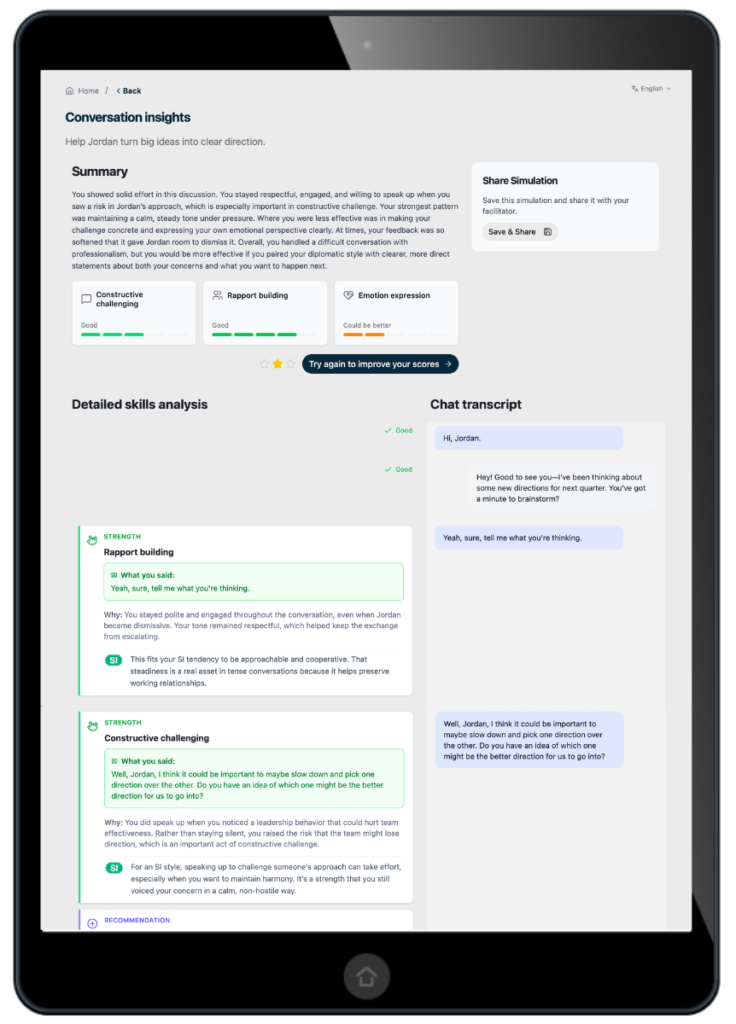
That kind of practice can be especially valuable because knowing that you should adapt your communication is one thing, but recognizing the moment when you need to do it–and figuring out what adaptation might actually look like–is another.
Virtual practice can support both new and experienced DISC learners, making it useful for the new hire experience and as ongoing reinforcement for the rest of the team. Reach out to us for more information about virtual DISC practice tools.
Summary / Next Steps
DISC tends to deliver the most value when it is not treated as a one-time event. Teams change, people change roles, new working relationships develop, and new challenges emerge.
You do not need to restart your DISC initiative every time that happens. Instead, think of DISC as something you can maintain as your team evolves.
- Give each new team member enough support to learn the team’s shared language.
- Use DISC to introduce communication preferences and team culture.
- Give new hires opportunities to talk about their own preferences, too.
- Revisit the model occasionally with the full team.
- Create opportunities to practice and reinforce the skills.
- Most importantly, keep connecting DISC to the real conversations and working relationships your team navigates every day.
A little intentional follow-through can extend the value of your original DISC investment for years while helping new employees feel like part of the team much sooner.
Need help using DISC to welcome new team members? Set up time for a quick conversation about assessments, onboarding resources, refresher workshops, or virtual practice tools.
"*" indicates required fields