
The 12 DISC Behavioral Tendencies Explained

Adam Stamm
Managing Partner: Online DISC Profile
Adam was first certified in DISC in 2018. Over the years, he has developed new DISC Products and other personality-based tools. He is a Managing Partner at Online DISC Profile, Chapter President of the Association of Talent Development Greater Philadelphia Chapter, and lives in Philadelphia, PA (USA).
Behavioral tendencies are the observable traits of your DISC Personality Type.
Our personality and behaviors are tightly woven. When we talk about a D Personality Type, we can immediately recognize the behaviors associated with that individual style (dominant, direct, etc.).
The DISC model defines each personality type based on a set of behaviors, which is why the styles are easily recognizable. However, just because you don’t receive a certain style doesn’t mean those tendencies don’t show up in the way you behave on occasion.
This article will review the 12 behavioral tendencies and show how they show up in everyone’s personality, regardless of DISC Style.
What are the behavioral tendencies in DISC?
The DISC model measures 12 distinct behavioral tendencies.
The chart below explains what each tendency means and measures, along with which DISC style is represented within each tendency.
If you are thinking about your own DISC style while reading this table and you don’t see your DISC style represented in a certain tendency, you likely choose a certain behavior within the tendency based on the situation.
We will go deeper into how these tendencies show up in all DISC Styles later; the purpose of this chart is to show an overview of all of the behavioral tendencies so you can see them at a glance.
| Behavioral Tendency | Description | DISC Style Representation |
|---|---|---|
|
Decision Making |
How you approach decisions and actions. |
Impulsive (I) or Catious (S) |
|
Change Preference |
How you engage with change. |
Drive Change (D) or Reluctant to Change (S) |
|
Work Process Alignment |
How you focus on process to follow through on work. |
Accuracy (C) or Consistency (S) |
|
Reasoning |
How you think through and solve problems. |
Intuition-Based (I) or Evidence-based (C) |
|
Prioritizing |
How you determine order for dealing with items or tasks. |
Results (D) or Rules (C) |
|
Self-Reliance |
How you work within a team |
Collaborative (I) or Directive (D) |
|
Building Rapport |
How you focus when interacting with others. |
Results-Focused (D) or Relationships-Focused (I) |
|
Providing Instruction |
How you dictate directions and expectations |
Reserved & Detailed (C) or Directive & Compulsive (D) |
|
Expressing Openness |
How you are most comfortable expressing yourself |
Structural (C) or Social (I) |
|
Planning Orientation |
How you focus your attention when making plans |
Predictability (S) or Precision (C) |
|
Personal Drive |
How your goals move things forward. |
Group-focused (S) or Self-Driven (D) |
|
Customer & Team Interaction |
How you engage with customers and stakeholders, internal or external. |
Supporting (S) or Engaging (I) |
Now that you have a list of all 12 behavioral tendencies, we will dig into each one to show how they show up in real life.
Reasoning
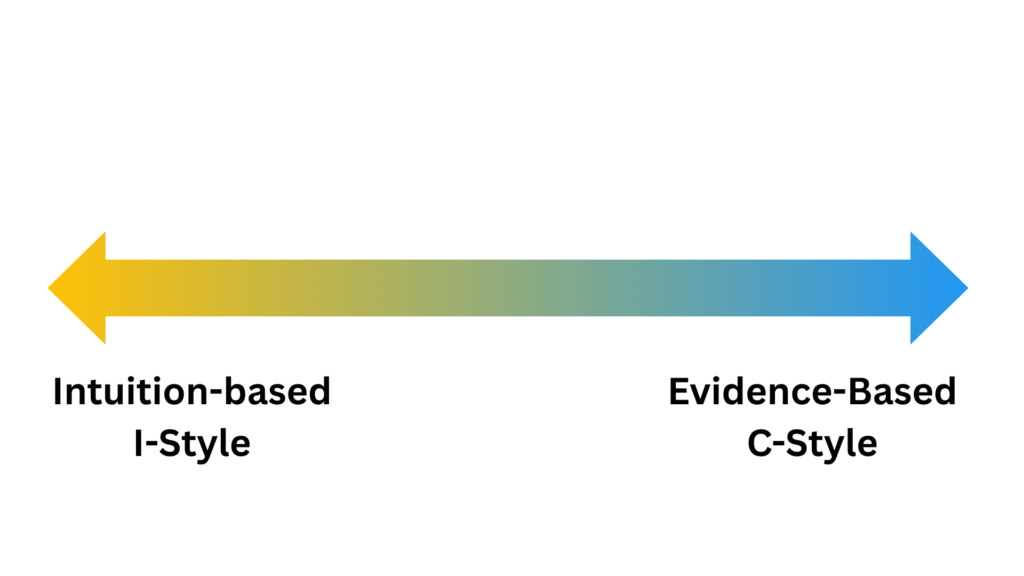
The Reasoning Behavioral Tendency is represented by the continuum of Intuition-Based (I-Style) and Evidence-Based (C-Style).
We all have the capacity to go with our gut (intuition) or follow the facts (evidence-based reasoning) when it comes to how we rationalize and problem-solve. However, those with the I-Personality Type will lean towards using their intuition, whereas those with the C-Personality Type will lean towards following the evidence when possible.
For the rest of us, it’s likely situational. As an example, Donald Trump is a perfect example of a D-Personality Type. He often makes intuition-based decisions. However, during the pandemic, Trump listened to evidence from Dr. Anthony Fauci and kept the country locked down to stop the spread of the COVID-19 virus.
Prioritizing
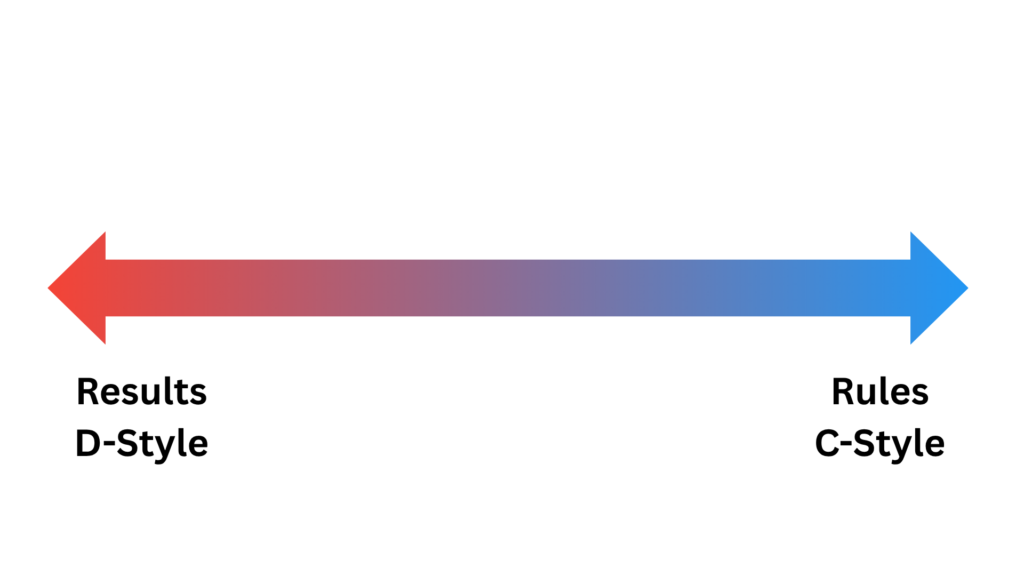
The Prioritizing Behavioral Tendency is represented with a scale focused on “Results” (D-Style) and “Rules” (C-Style) at opposite ends.
This continuum is often played out publicly, at least in the United States, within the Federal Government (rules) versus politicians and voters (results).
The Government, as an entity, is very Rule-Based, whereas many highly visible politicians are Results-Based. It’s possible to see this in other organizations as well when new leaders are brought on board.
When Elon Musk (A DI Personality Style) took over Twitter (Now X), his first priority was to eliminate what he felt were rules holding the company back from results (i.e., work-from-home policies). We see this again when Musk was brought by the Trump administration to lead the Department of Government Efficiency (DOGE).
For those of us who don’t have a style that is represented on this scale, we will situationally choose where to stand on either end of the scale. We might lament about work-from-home policies being taken away while believing the Government should be more efficient (or vice versa).
Decision Making
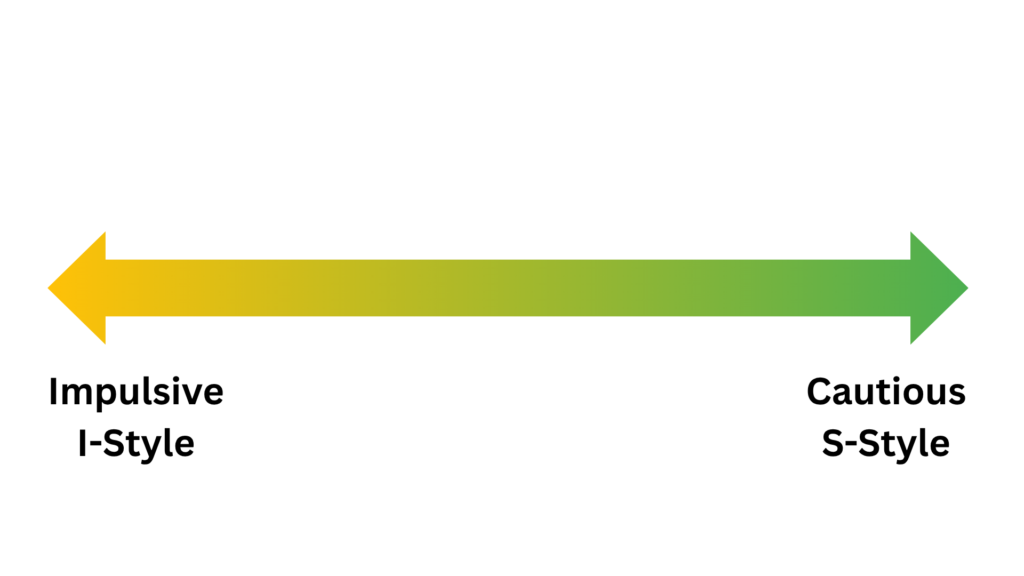
The Decision-Making scale consists of cautious (S-Style) on one side and impulsive (I-Style) on the other.
This scale is often easy to see within technology companies between leaders, who have DI personality types, and their engineers, who have more C- or S-Personality types. Leaders will see their competitors entering a new market or using a new technology or process, and they will try to bring it back to their organization to the dismay of their engineers.
This relationship was most well seen between Steve Jobs and Steve Wozniak. Jobs seemingly changed everything about himself: what he wore, his goals and ambitions, and where he worked. Steve Wozniak didn’t operate in that manner and was put off by the direction Jobs was going.
Work Process Alignment
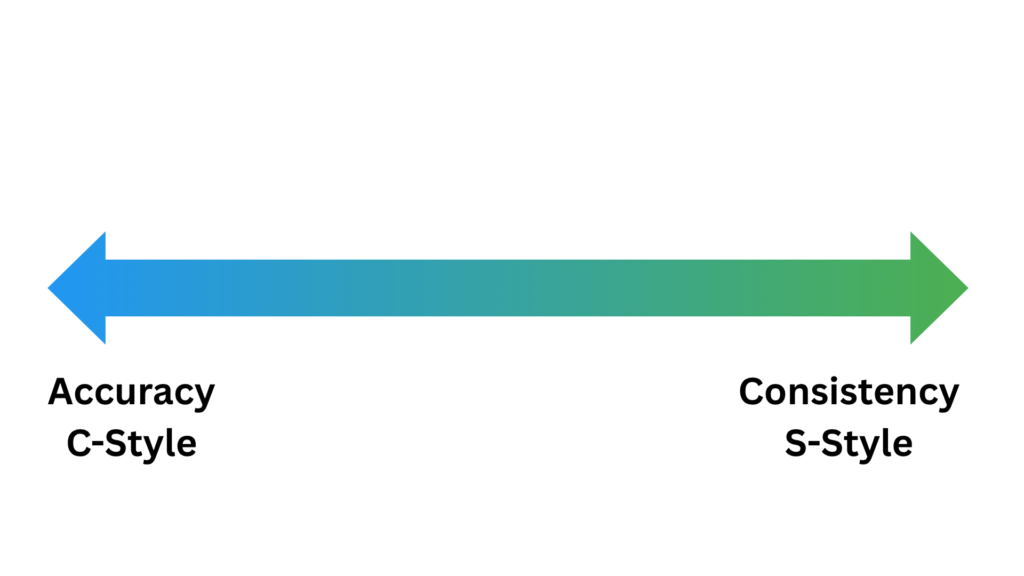
The Work Process Alignment scale comprises Consistency (S-Style) and Accuracy (C-Style) on opposite ends of the continuum.
This behavior showcases how someone focuses on process to follow through on work. Do they spend time ensuring work is highly accurate, or do they focus on a system to keep work moving at a methodical pace?
It’s important to clarify that those on the predictability side of the equation don’t intend to release inaccurate work. Rather, their behavior relies on accuracy happening through a designed system rather than spending lots of time upfront to ensure precision.
An example that helps explain how these two forces work is how Google and Apple release their products. Apple produces a closed-system product that works the way they intend it to work. Google, on the other hand, releases products that are more malleable and open-source. Their software can be integrated into lots of other systems. Their mobile operating system, Android, is usable by other mobile phone hardware producers in addition to their own phones.
Both products are viable, but they have different workflows for releasing their products.
Self-Reliance
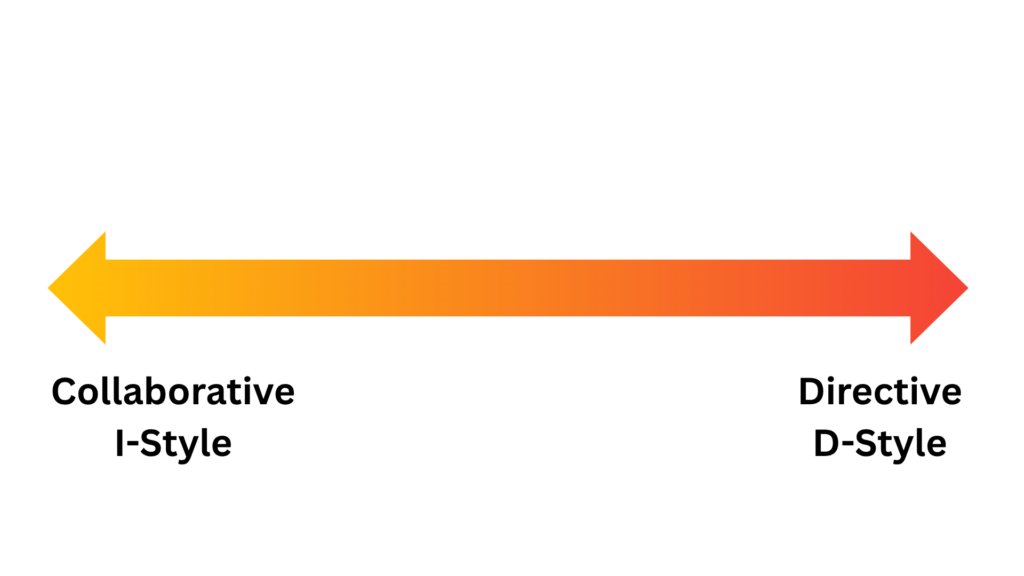
The Self-Reliance behavioral tendency showcases how an individual works on a team. This tendency measures whether someone is Collaborative (I-Style) or Directive (D-Style).
Is the person looking to build consensus amongst a group, or are they more willing to give the group direction based on their preferences?
As in the other behavioral tendencies, if you don’t have any D or I in your behavioral profile, you will lean into either area based on the situation. In my experience with the team I manage, I’m more directive in a group setting and collaborative in a 1:1 setting.
Change Resistance
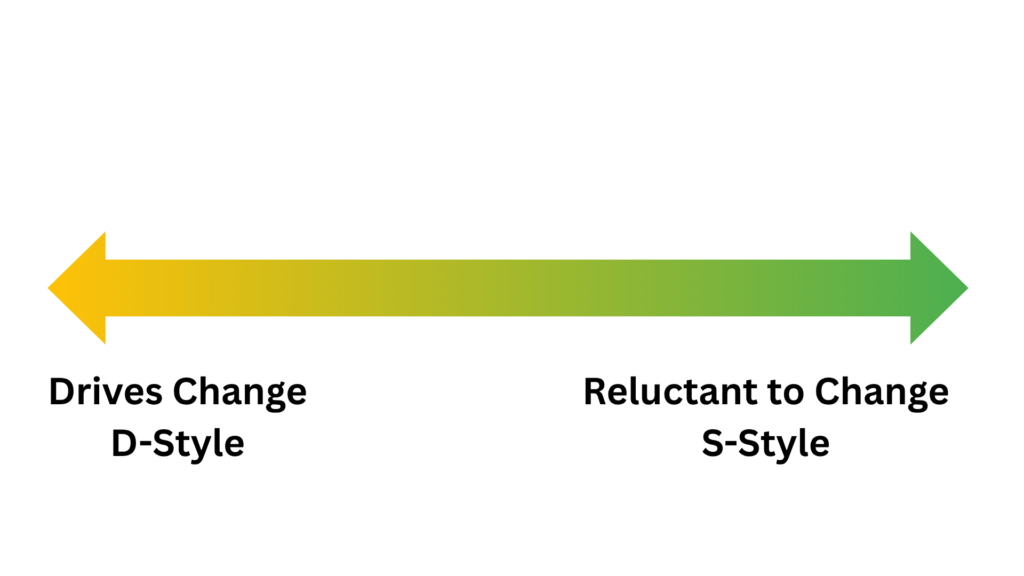
The Change Resistance behavioral tendency looks at your perception of change. One side of the continuum prefers driving change (D-Style), and the other side is more hesitant to change (S-Style).
Early American (United States) history shows many examples of this continuum at play. In the 1790s, Alexander Hamilton wanted a strong federal government capable of building a modern industrial economy with credit, a central currency, and infrastructure.
Thomas Jefferson, on the other hand, feared central financial control would breed corruption, destroy rural agrarian independence, and exceed the constitutional mandate. He favored state autonomy and strict limits on federal power.
This conflict over the federal government’s change continues today!
Personal Drive
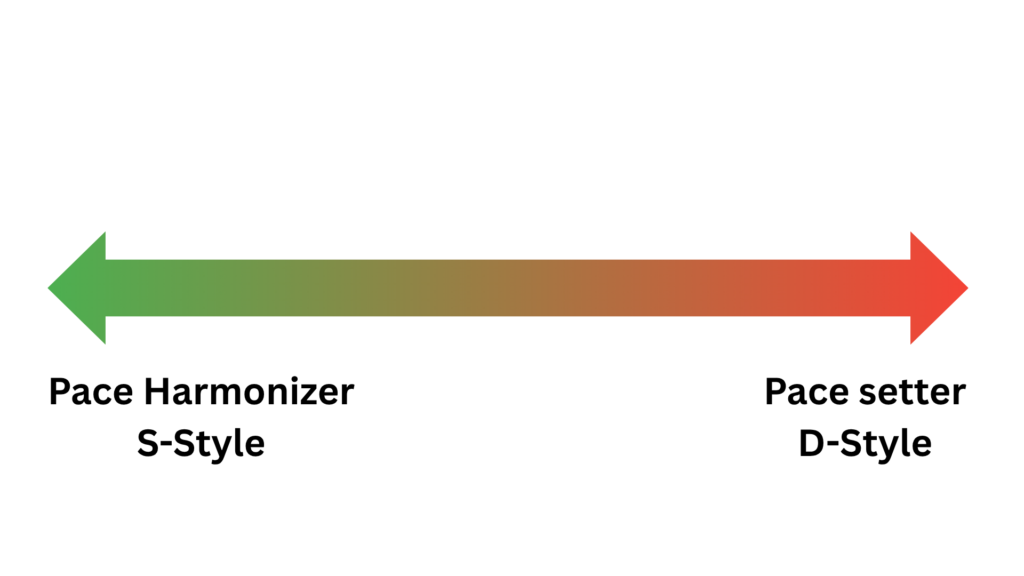
The personal drive behavioral tendency consists of one side leaning toward setting the pace for change, goals, or direction (D-Style), and the other side trying to anchor or ground the pace so it’s achievable for everyone (S-Style).
A fictional example is from the TV show Parks and Recreation. Characters Leslie Knope (Pace Setter) and Ben Wyatt (Pace Harmonizer) play these two roles. Leslie operates with boundless energy and wants to launch massive civic overhauls.
Ben Wyatt is a pragmatic city manager who steps in to ground Leslie’s ambitions in financial and physical reality to ensure her vision can actually be sustained in the long-term.
Building Rapport
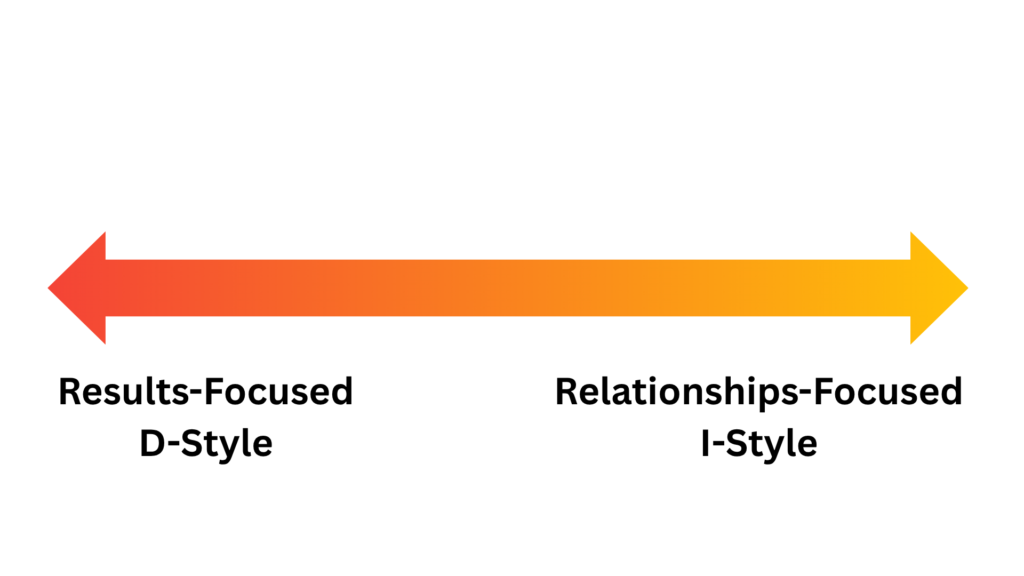
The building rapport behavioral tendency concerns how someone approaches interactions with others. This tendency examines whether someone focuses on results (D-Style) or relationships (I-Style).
A fictional example of this relationship takes place in the TV show Ted Lasso.
Ted Lasso famously declares that he doesn’t care about wins and losses as much as helping each player become the best version of themselves.
Roy Kent (and also Nathan Shelley) behave entirely on the results-focused side of the spectrum, focusing heavily on tactical execution, toughness, wins, and accountability on the pitch.
Planning Orientation
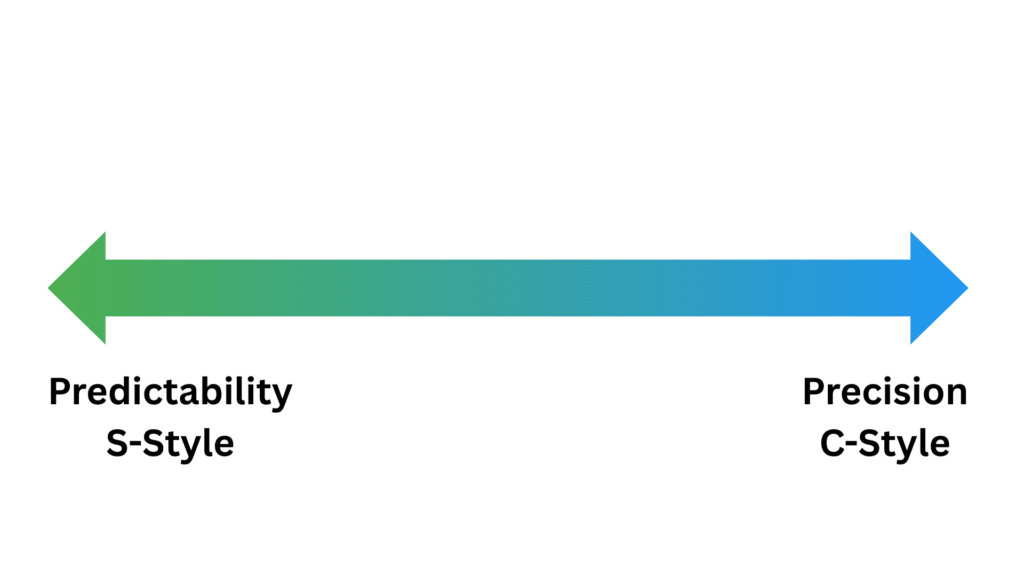
The planning orientation behavioral tendency focuses on high performance with very different metrics. On one side, this tendency focuses on precision and perfection (C-Style), and on the other side, it focuses on predictability, repeatability, stability, and low variance (S-Style).
How does this behavioral tendency show up in life?
Compare McDonald’s to a 3-Star Micheline restaurant.
These two entities might seem far off, but they both represent extreme high performance in the eating experience. When you go to a McDonald’s, anywhere in the world, you know exactly what you are about to purchase. It’s a predictable experience.
On the other hand, a 3-Star Michelin restaurant delivers a very specific experience that is unique and curated with precision by the chef.
Imagine the communication issues if two leaders had these two different goals in mind for their next food-service operation! This is one of the many reasons why DISC can improve communication.
Customer & Team Interaction
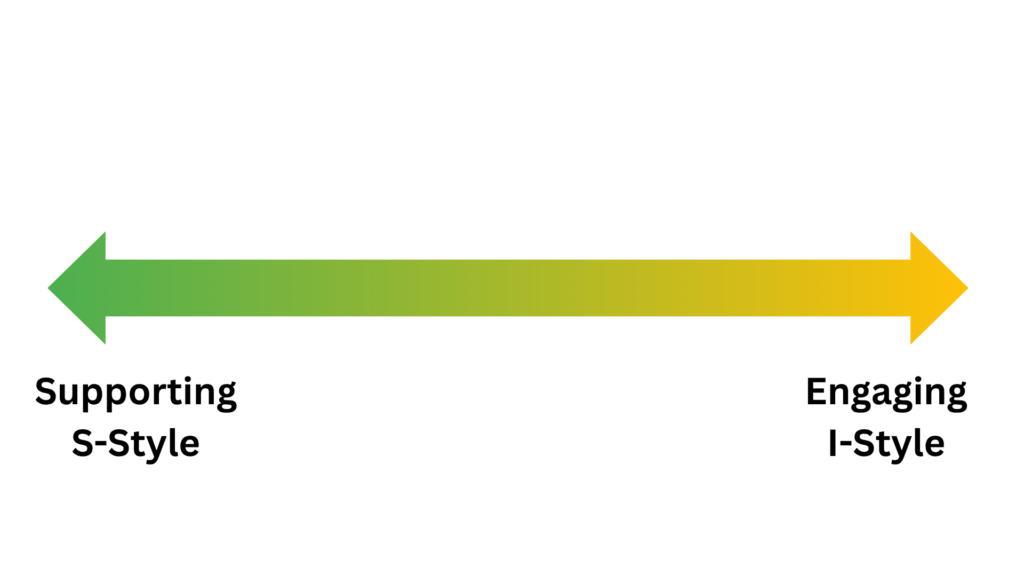
The Customer & Team Interaction measures how someone engages with customers and stakeholders (internal and external). It compares whether you are more supportive (S-Style) or engaging (I-Style).
When thinking about leaders on this continuum, you will find a dynamic of Servant leaders (Supporting) or Charismatic leaders (Engaging).
Real-life examples include Satya Nadella (Microsoft) and Richard Branson (Virgin). In this example, Branson’s company is well-known because of Branson’s personal brand. He leads with charisma and his personal magnetism.
Nadella, on the other hand, shifted Microsoft toward building systems, unblocking teams, listening, and giving his managers tools to innovate autonomously without his direct presence.
Teaching these differences in leading could be a game-changer in your organization’s onboarding process, and it’s one of the many reasons we highly recommend DISC as a primary tool for onboarding new employees.
Providing Instruction
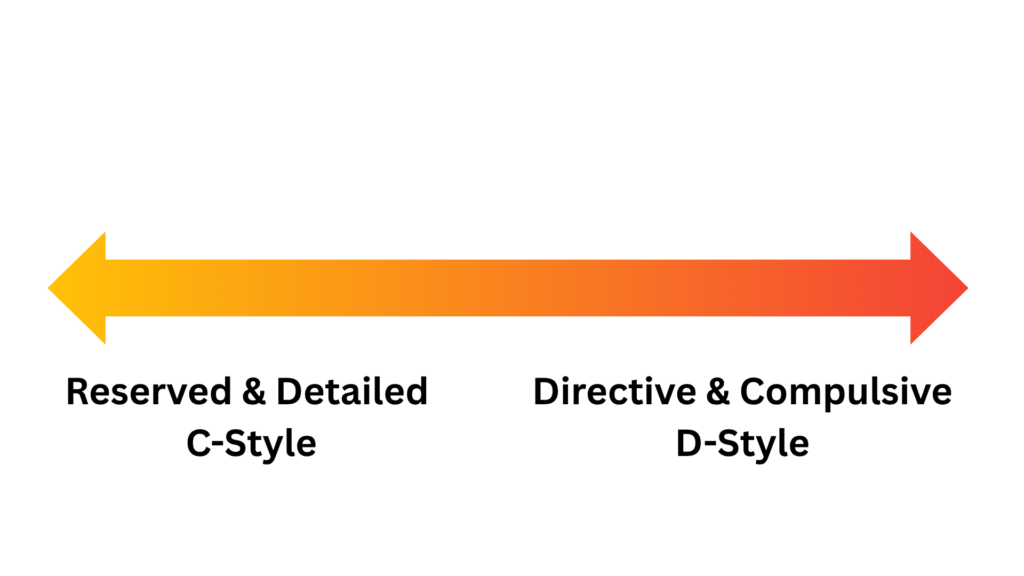
The Providing Instruction behavioral tendency measures whether a person is reserved & detailed (C-Style) or directive & compulsive (D-Style).
This behavioral tendency focuses on how an individual dictates directions and expectations.
Two characters from the sitcoms The Office and Brooklyn 99 come to mind immediately: Michael Scott (directive & compulsive) and Captain Raymond Holt (Reserved & Detailed).
In real life, Tim Cook (reserved & detailed) and Steve Jobs (directive & compulsive) are also great examples. See our full list of famous people and their DISC personality styles.
Reserved & Detailed leaders are known for their quiet intensity. On the other hand, Directive & Compulsive leaders take complete control over every detail.
Expressing Openness
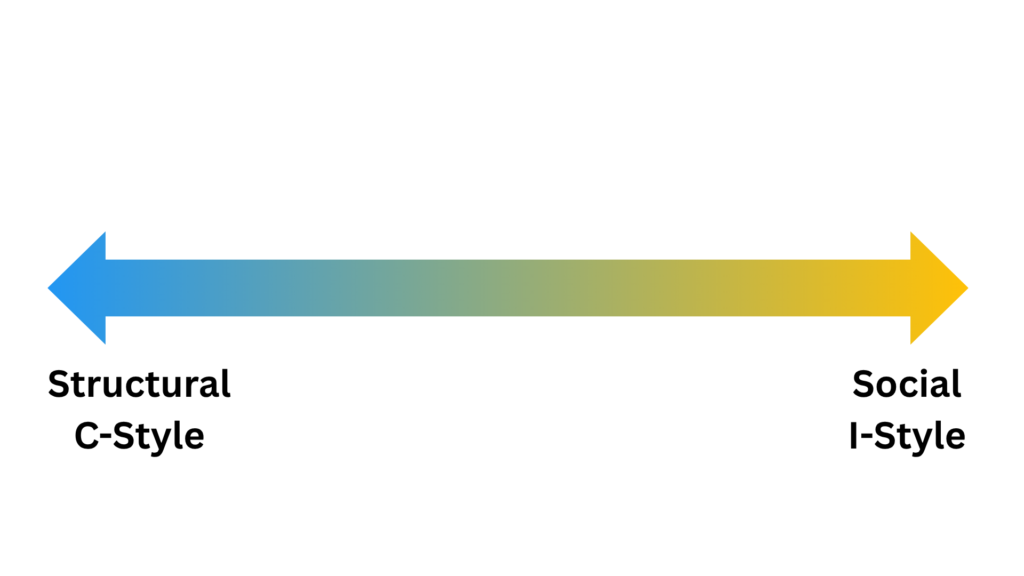
The Expressing Openness behavioral tendency measures whether someone is a Structural (C-Style) or Social (I-Style).
This behavioral tendency aims to determine how comfortable someone is expressing themselves.
Anthony Bourdain is a living example of someone who had high social ability. Bourdain approached human differences with curiosity and without judgment.
In the show, The Queen’s Gambit, Beth Harmon is a chess prodigy who struggles with personal relationships, emotional processing, and social norms. Her openness is almost entirely bound to the abstract geometry of chess.
Why understanding tendencies matters for your team
When working on teams, minor interactions can cause rifts in relationships. Understanding the behavioral tendencies of your colleagues and teammates will clarify their motivations – especially when they’re very different from your own.
For example, the Planning Orientation behavioral tendency could destroy a leadership team if they are two opposite sides of the spectrum.
We used the example of McDonald’s (Predictability) and a 3-Star Micheline restaurant (Precision). Both establishments serve food, but they go about it in very different ways. By understanding a person’s tendency and motivation, it’s easier to understand their perspective and opinion.
The behavioral tendencies allow you to hone in on specific interactions that might not fit within the four main personality styles. Additionally, it can help you understand why someone like your boss doesn’t understand you!
When leaders have the knowledge of DISC, they can help navigate style and behavioral tendency differences to resolve tension.
How to close the perception gap with DISC
The DISC Behavioral Tendencies allow you to go deeper into a person’s behavioral profile. These insights deepen your perspective and appreciation for a person’s unique personality.
The goal in using DISC and the 12 behavioral tendencies is to deepen collaboration and interpersonal relationships. These insights, when paired with the platinum rule, will transform groups and workplaces.
Looking to start using DISC?
Get in touch with our team and we can help!
"*" indicates required fields