
What are the 12 DISC Personality Types?

Adam Stamm
Managing Partner: Online DISC Profile
Adam was first certified in DISC in 2018. Over the years, he has developed new DISC Products and other personality-based tools. He is a Managing Partner at Online DISC Profile, Chapter President of the Association of Talent Development Greater Philadelphia Chapter, and lives in Philadelphia, PA (USA).
DISC is a tool for learning about yourself and communicating better with others. The 12 DISC personality types offer a nuanced way to understand your personality, communication preferences, goals, motivations, and even stressors.
The DISC model is broken out into four main DISC types: Dominance, Influence, Steadiness, and Conscientiousness.
These four styles represent the core structure of the DISC model of behavior. Once you learn the four DISC profile types, you can see these styles represented in friends, colleagues, or even famous individuals you know from the government or TV.
However, each Style can be combined with an adjacent style to provide a deeper insight into an individual’s personality. A combination profile (i.e., SC-Style or DI-Style, etc.) blends the identifying features of each combined style into its own unique DISC Style. These blended profiles are no better than (or worse) than having a single, primary style like a D-Style or I-Style.
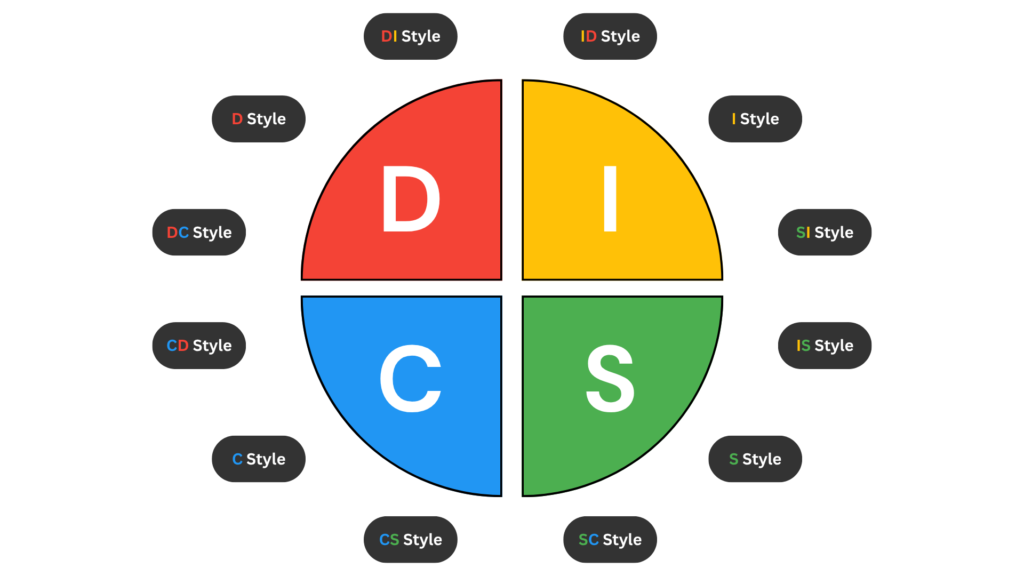
Someone with a flipped profile (like DI or ID-Style) has a unique style. Their general characteristics report (included in the Full DISC Profile) will be similar but also differ in many ways.
The 12 unique DISC assessment types, or DISC styles, provide an essential perspective on how people differ in their motivations, fears, stressors, and communication.
In this article, we will explain how to identify and understand each of the 12 DISC personality types.
Managing a team and looking for help?
DISC will help you build a better culture and stronger, more productive teamwork. Read more about DISC for Teams or schedule a consultation with our team to get started.
DISC Personality Types Chart Comparison
The four DISC personality styles are very easy to understand and measure. The table below clearly shows key differences between each personality type.
However, what happens if someone is both Direct (D-Style) and Persuasive (I-Style) or Diplomatic (C-Style) and Patient (S-Style). These blended DISC styles create an additional 8 personality styles for a total of 12 unique styles.
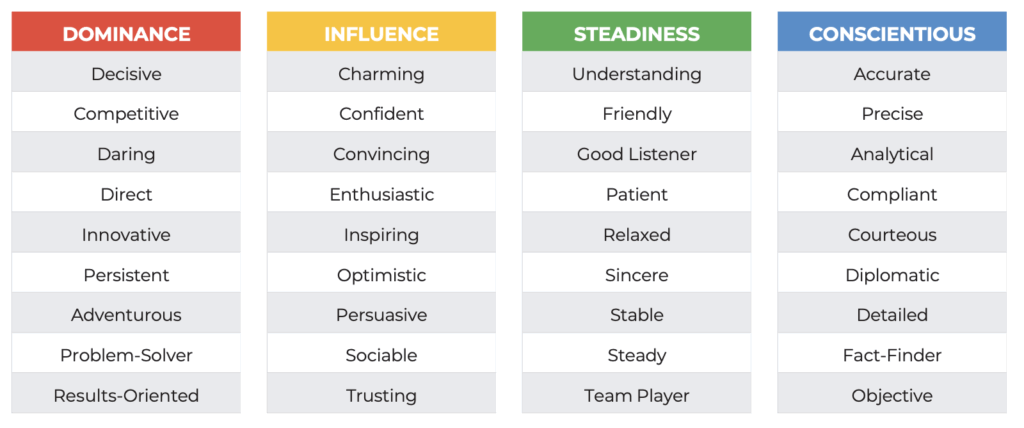
Blended DISC Styles are no different than profiles that only have a single DISC style (however, blend profiles are more common DISC Styles to have). There are no bad or good DISC styles – each profile is unique to you and how you answer the assessment.
The 12 DISC Personality Types
The 12 DISC Personality Types are presented to help you understand the similarities and differences between each category of style. We will highlight famous individuals DISC Style, highly correlated jobs, and more in each section!
The jobs and roles that correlate with each style are just that – correlations. DISC Basic doesn’t predict job performance, and it can still support the hiring process.
Wait.. Aren't there 16 Personality Types?
There are not 16 DISC Personality Types. There are only 12.
The ’16 Personalities’ are based on a different model called Myers-Briggs (MBTI). Read our comparison of these two tools here. Personality is difficult to measure, and each assessment offers a different point of view, like looking through multiple windows into a house. Each window offers its own perspective, which helps us better understand what’s going on inside.
D - Dominance
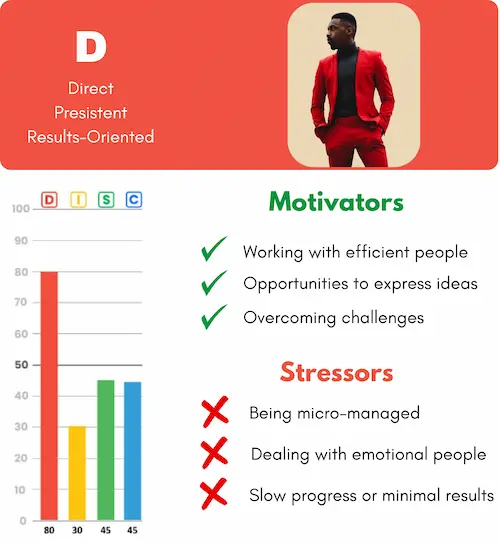
The Dominance (D personality type) is defined by decisiveness and competitiveness. People with this personality type are:
- Direct
- Results oriented
- Strong willed
This DISC assessment chart will show high Dominance scores.
People with this style likely seek control over situations and others. They are highly skeptical and fast-paced. They tend to be direct, if not blunt, with their opinions.
Highest Self-reported Jobs and Roles for this style:
- Executive
- Mid-Level Management
- Supervisory
- Warehouse / General Labor
Famous D-Personality Types:
- Angela Merkel
- Michael Jordan
- Gordon Ramsay
DI - Dominance Influence
The Dominance-Influence (DI personality type) is:
- Assertive
- Persuasive
- Results driven
When a person with this style has a great idea, they are likely to persuade everyone around them to take action. The DI personality type tends to be impatient and to view situations through a “win-lose” lens.
Highest Self-reported Jobs and Roles for this style:
- Executive
- Sales
- Skilled Trades
- Supervisory
Famous DI-Personality Types:
- Steve Jobs
- Madonna
- Tony Robbins
DC — Dominance Conscientious
The blend of Dominance and Conscientious (DC Personality Type) produces a strong-willed personality. These individuals are
- Determined
- Excel at critical thinking
- Skeptical and Questioning
People with a DC personality type want to feel like experts in their field and fear failing to meet their own high standards.
Highest Self-reported Jobs and Roles for this style:
- Management Consultant
- Engineering Director
Famous DC-Personality Types:
- Barack Obama
- Condoleeza Rice
- Jeff Bezos
I — Influence
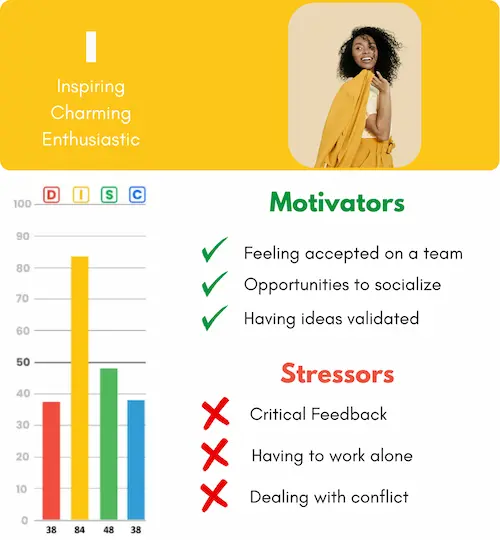
The Influence style (I personality type) is defined by
- Magnetism
- Collaboration
- Enthusiasm
People who rate high in Influence seek social recognition. They trust others quickly and come across as upbeat and energetic.
This DISC assessment chart will show high Influence scores.
Highest Self-reported Jobs and Roles for this style:
- Sales
- Teacher-Educator
Famous I-Personality Types:
- Dolly Parton
- Will Smith
- Robin Williams
ID — Influence Dominance
The Influence-Dominance (ID personality type) is similar to the DI-style, but instead of Dominance being the primary personality, Influence takes the lead.
ID people tend to be:
- Highly influential
- Upbeat
- Enthusiastic
Their biggest fear is being trapped in a fixed environment or losing the approval of others.
Highest Self-reported Jobs and Roles for this style:
- Sales Executive
- Supervisory
- Teacher / Educator
Famous ID-Personality Types:
- Richard Branson
- Oprah Winfrey
IS — Influence Steadiness
The Influence-Steadiness style (IS personality type) is defined by high levels of empathy and a need to connect with others. People with this personality are:
- Welcoming
- Easygoing
- Trusting
On the other hand, they tend to take criticism personally and try to avoid conflict.
Highest Self-reported Jobs and Roles for this style:
- Customer Service
- Teacher Educator
- Health Care
Famous IS-Personality Types:
- Ellen DeGeneres
- Jimmy Fallon
- Fred Rogers (Mister Rogers)
S — Steadiness
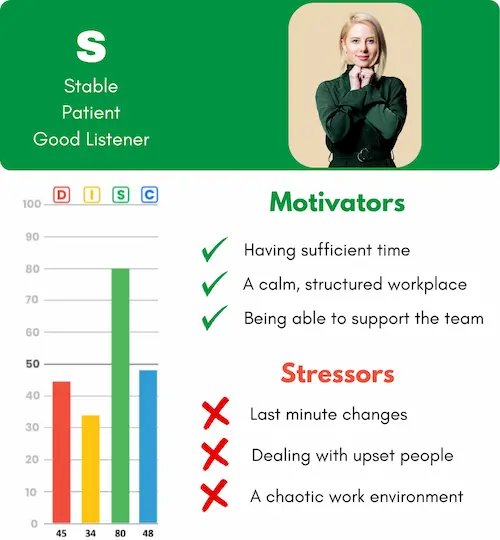
People with a primary Steadiness style (S personality Type) value:
- Consistency
- Harmony
They are likely to give others the benefit of the doubt and like to play a supportive role. If not careful, strong S personalities might have difficulty advocating for their own needs or retreat to more passive roles.
This DISC assessment chart will show high Steadiness scores.
Highest Self-reported Jobs and Roles for this style:
- Health Care
- Secretarial / Clerical
- Teacher Educator
Famous S-Personality Types:
- Mother Teresa
- Jimmy Stewart
- David Beckham
SI — Steadiness Influence
People with the Steadiness-Influence (SI) personality type are cheerleaders who want everyone to feel welcome. With a dominant S Personality type, SI people are:
- Conflict-averse
- Seek to serve others
They look for ways to bring people together and will prioritize the group over themselves.
Highest Self-reported Jobs and Roles for this style:
- Customer Service
- Teacher / Educator
- Health Care Worker
Famous SI-Personality Types:
- Bob Ross
- Michelle Obama
- Tom Hanks
SC — Steadiness Conscientious
The Steadiness-Conscientious style (SC personality type) is characterized as:
- Risk aversion
- Modesty
SC people value stability and tend to be soft-spoken. They are highly reflective and cautious and prefer to work behind the scenes to make things happen.
Highest Self-reported Jobs and Roles for this style:
- IT
- Warehouse / General Labor
- Mechanical Technical
Famous SC-Personality Types:
- Sully Sullenberger
- Walter Cronkite
C — Conscientious
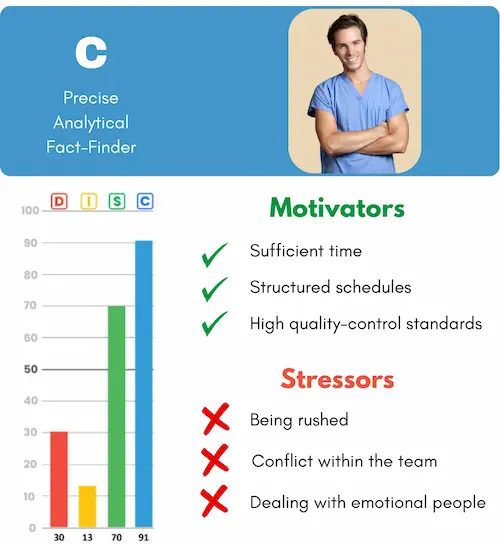
People who rate primarily as Conscientious (C personality Type) are:
- Methodical
- Precise
They tend to be great critical thinkers and highly value objectivity. They are determined to stick with a problem until it’s solved and excel at noticing small details.
This DISC assessment chart will show high Conscientious scores.
Highest Self-reported Jobs and Roles for this style:
- Assembly Worker
- IT
- Mechanical / Technical
Famous C-Personality Types:
- Bill Gates
- Albert Einstein
- Isaac Newton
CD — Conscientious Dominance
The Conscientious-Dominance style (CD personality type) is all about using logic to control situations. People who rate as CD tend to overcome obstacles thanks to the high standards they hold for themselves — and others. People with this style seek:
- Strong resolutions
- Efficient results
Highest Self-reported Jobs and Roles for this style:
- IT Supervisor / Manager
- Engineer
Famous CD-Personality Types:
- Simon Cowell
- Kevin O’Leary
CS — Conscientious Steadiness
The last of the 12 DISC personality types is Conscientious Steadiness (CS Personality Type). The CS style sees two sides to every problem and value reliable outcomes. They are defined by:
- Having a high level of attention to detail
- Can sometimes err on the side of perfectionism.
They are careful and prepared for every situation.
Highest Self-reported Jobs and Roles for this style:
- Secretarial / Clerical
- Warehouse General / General Labor
- Mechanical / Technical
Famous CS-Personality Types:
- Warren Buffet
- Marie Curie
- Dr. Anthony Fauci
How to Read Your DISC Assessment Chart
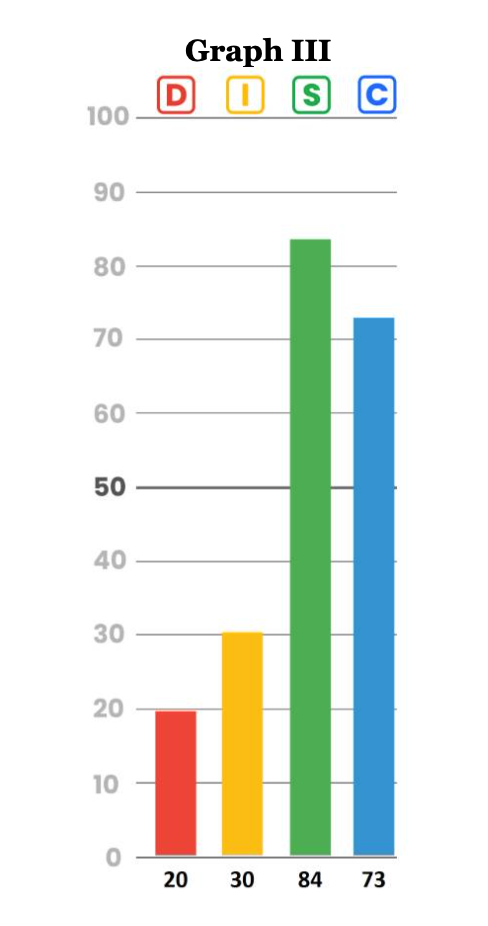
When you complete a DISC assessment, you will receive a chart that shows your DISC style along with a number score at the bottom of your graph for each primary style.
The higher your bar graph, the more inclined you are toward that particular style.
On this particular DISC assessment graph, you will see the following scores:
- D = 20
- I = 30
- S = 84
- C = 73
The cut off for receiving a DISC letter is a score of 50.
This person scored above a 50 on both the S Personality Type and C Personality Type, and they received a SC Style. This style is the third most common DISC style.
What does having a 'high' DISC style mean?
If you talk to someone who has used DISC for a long time, you might hear them say the phrase, “they have a high D style” or “they have a high S style”. This phrase comes from looking at the bar graph report and points out someone who has a single high bar graph compared to the other DISC bar graphs.
Learn your DISC Style
Whether you’re more like a DI or a CS, learning about your DISC personality type can help you better navigate daily life situations. There is no “good” or “bad” type. All 12 DISC personality types have their strengths and weaknesses, and understanding your personality type can be a significant first step toward growth and self-awareness.
As you’ve read through the 12 DISC personality types, you likely thought of people in your life — a boss, a friend, a family member — that fit one of these personality types. You may even see yourself in one or more of these types.
Do you want to know more about your DISC personality type? Complete a free DISC test, get a DISC Basic report, or explore in-depth options like DISC for leadership or DISC for teams. You’ll not only find out which of the 12 DISC styles you are, but also how that personality type informs your motivations and how you can better communicate with contrasting personality types.