
Understanding buyer behavior with DISC

Kristin Emerson
Training Director
Kristin worked as a professor at NC State prior to working in Talent Development. Since leaving the world of academia, Kristin has worked with organizations both large and small helping to improve team culture, emotional intelligence, and leadership development.
There is no single best approach to sales. A pitch that feels clear and efficient to one buyer might feel rushed to another. A detailed proposal that reassures one decision-maker might overwhelm someone else. That is why understanding buyer behavior is so important.
DISC gives sales professionals a practical way to recognize how different buyers prefer to communicate, make decisions, ask questions, and evaluate risk. Instead of relying on a single script, DISC helps sales teams adjust their pace, tone, level of detail, and follow-up strategy to fit the buyer in front of them.
This article explores how DISC can help you understand the 4 types of buying behavior, recognize blended buyer styles, and pitch more effectively to groups with mixed priorities.
This article focuses specifically on applying DISC in sales conversations. For a foundation in the model itself, start with What is DISC?.
Reading people at a glance
A DISC personality test can help salespeople understand their own style and prepare for different buyer needs. But in real sales conversations, you usually do not have a buyer’s DISC report in front of you. You have to listen, “read the room,” and adjust.
DISC training helps salespeople notice patterns in buyer behavior without reducing people to labels. The goal is not to “type” someone perfectly. The goal is to gather clues about what makes the buyer feel comfortable, confident, and ready to move forward.
| Buyer cue | Possible DISC clue | What it may mean for your sales approach |
|---|---|---|
|
Speaks quickly, interrupts, and asks for the point |
D or I tendency |
Keep the pace moving. Lead with value, outcomes, and next steps. |
|
Asks for data, process, specifications, or proof |
C tendency |
Provide evidence, documentation, and clear logic. Avoid vague claims. |
|
Responds warmly, tells stories, engages socially |
I or S tendency |
Build rapport. Use examples, testimonials, and collaborative language. |
|
Hesitates, asks about support, implementation, or impact on others |
S tendency |
Slow down. Reduce uncertainty and show how change will be managed. |
|
Challenges assumptions or pushes back quickly |
D or C tendency |
Stay confident. Support your recommendation with logic and results. |
|
Goes quiet or stops engaging |
S or C under pressure |
Pause, check for concerns, and invite questions without forcing urgency. |
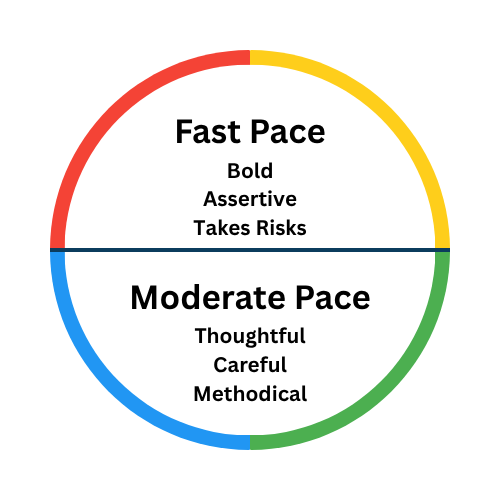
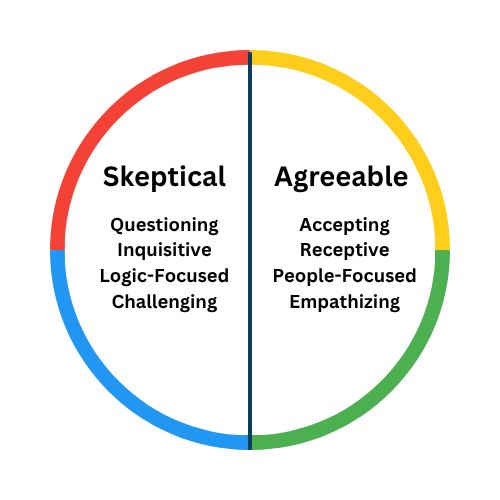
A helpful way to analyze buyer behavior is to look at three things at once: what the buyer talks about most, how quickly they move, and what seems to create hesitation.
DISC gives structure to that observation, and you can see that structure in the two images below, which form the foundation of the questions asked during the formal DISC assessment process.
You can also combine DISC with other frameworks.
For example, the Big 5 personality traits in consumer behavior often look at openness, conscientiousness, extraversion, agreeableness, and emotional stability. DISC is different because it focuses more directly on observable behavior, communication preferences, pace, and priorities, which makes it especially useful during live sales interactions.
Decoding the four core sales personas with DISC
Every DISC style buys; the difference is how each style evaluates trust, risk, value, and urgency.
DISC does not replace product knowledge or a strong sales process. It helps the salesperson decide how to communicate that knowledge in a way the buyer can actually receive. That is the heart of the Platinum Rule: treat others as they wish to be treated.
The "Dominant" buyer
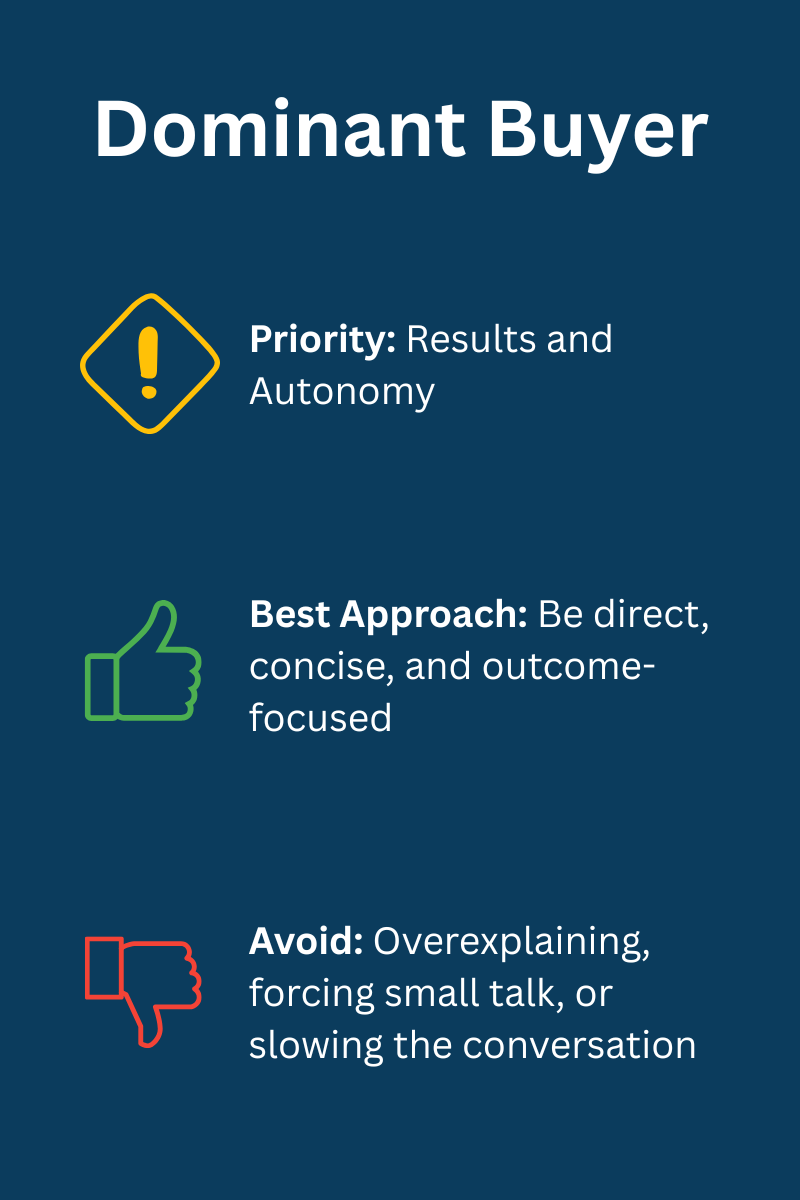
A Dominant buyer (D-Personality Type) is often focused on outcomes, speed, control, and impact. They may ask direct questions, challenge assumptions, and want to know why your solution is worth their time.
| What they may be thinking | How to respond |
|---|---|
|
“What is the bottom-line value?” |
Lead with results, ROI, or strategic impact. |
|
“Can this solve my problem quickly?” |
Show the shortest path from problem to outcome. |
|
“Do I have options?” |
Give clear choices and let them decide. |
With a D-style buyer, do not mistake brevity for disinterest. They may be engaged precisely because they are cutting to the point. Use a confident tone, give them control where possible, and avoid burying the recommendation under too much background.
Example: Instead of saying, “Let me walk you through all of the context first,” try, “The short version is that this option gives you the fastest rollout with the least disruption. I can show you the details behind that if it’s useful.”
The "Influencing" buyer
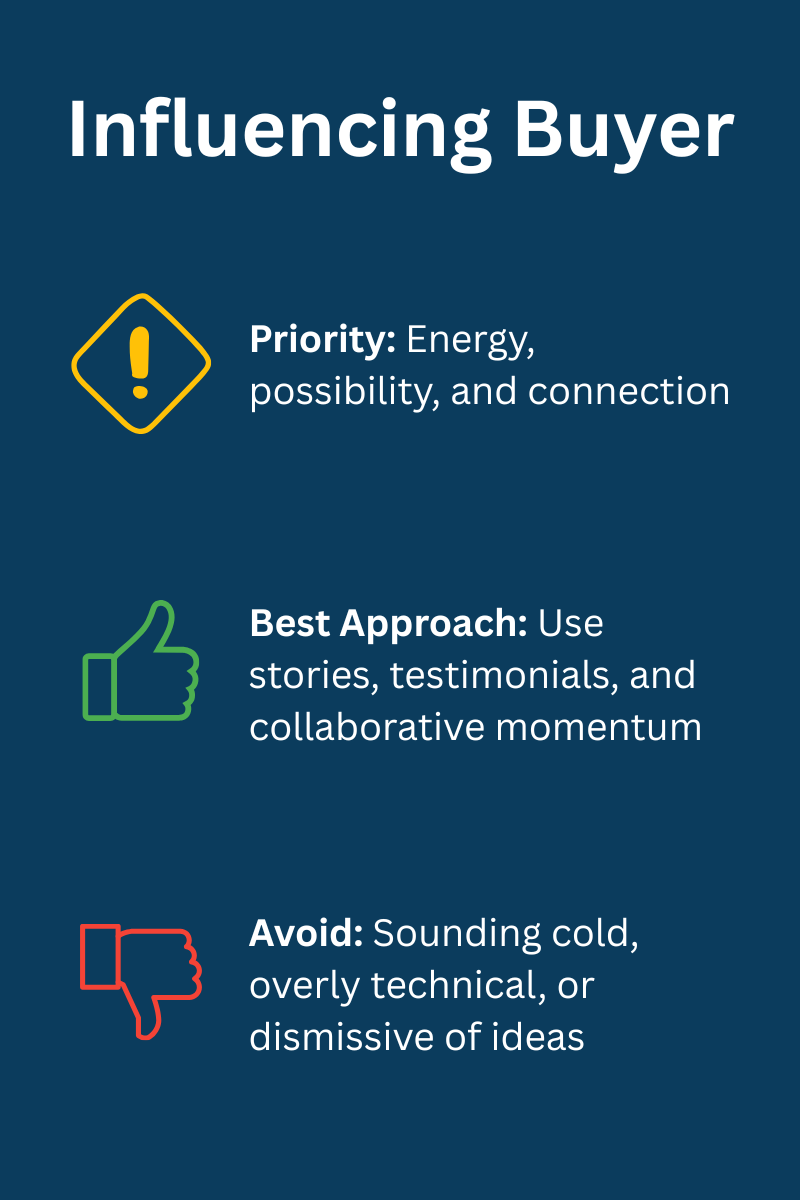
An Influencing buyer (I-Personality Type) is often energized by ideas, possibilities, recognition, and social proof. They may respond well to enthusiasm, stories, innovation, and examples of how others have succeeded.
| What they may be thinking | How to respond |
|---|---|
|
“Is this exciting?” |
Show the vision and potential upside. |
|
“Who else is doing this?” |
Share case studies, examples, or testimonials. |
|
“Will this make us look good?” |
Connect the solution to visibility, innovation, and team success. |
An I-style buyer may think out loud. They might explore options before they are ready to commit. Salespeople can help by matching their energy while still creating structure.
Example: “There are a few exciting ways this could work. Let me capture the strongest ideas, then we can narrow them into the best next step.”
The "Steady" buyer
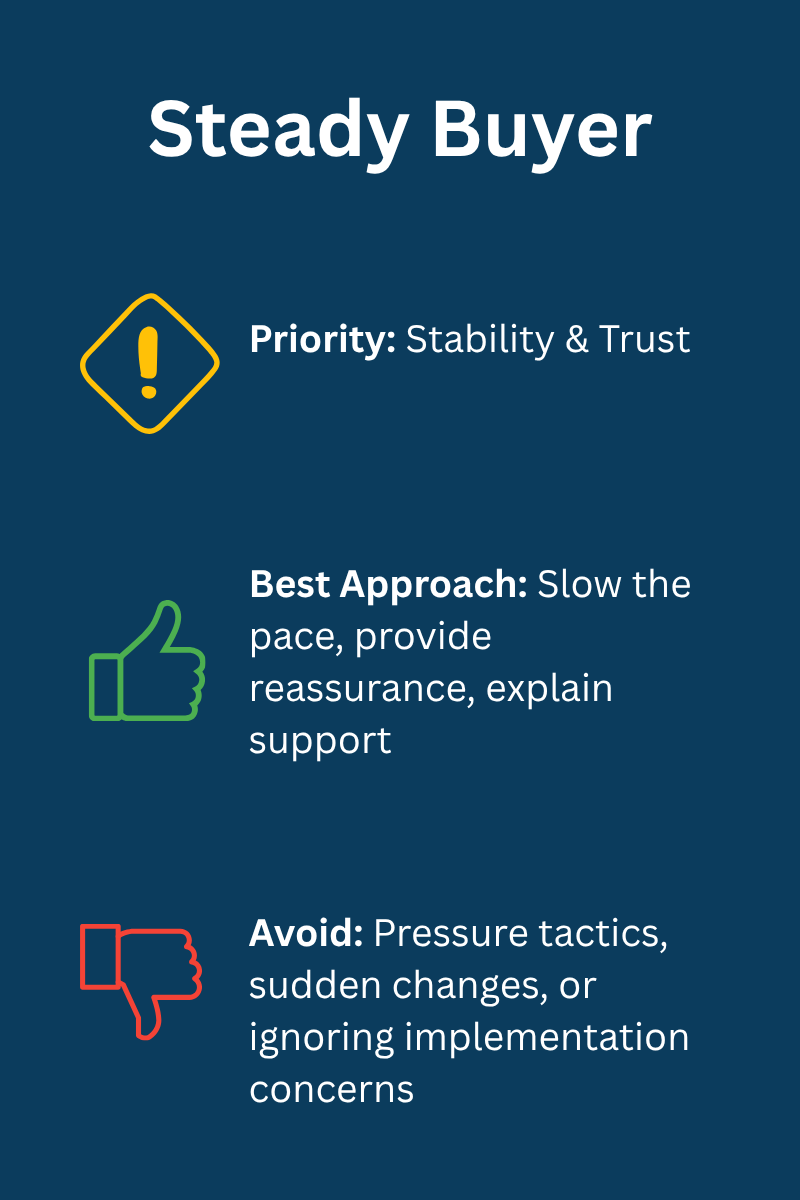
A Steady buyer (S-personality Type) is often focused on trust, stability, support, and reducing disruption. They may need time to process, involve others, and feel confident that the solution will not create unnecessary conflict or risk.
| What they may be thinking | How to respond |
|---|---|
|
“Will this disrupt my team?” |
Explain the transition plan and support structure. |
|
“Can I trust this person?” |
Be consistent, patient, and transparent. |
|
“What happens after we buy?” |
Talk through onboarding, service, and follow-up |
An S-style buyer may not voice objections immediately. Silence does not always mean agreement. It may mean they need more reassurance, more time, or more clarity about how the decision affects people.
Example: “I know this would be a change for your team. Would it help if we talked through what the first 30 days would look like?”
The "Conscientious" buyer
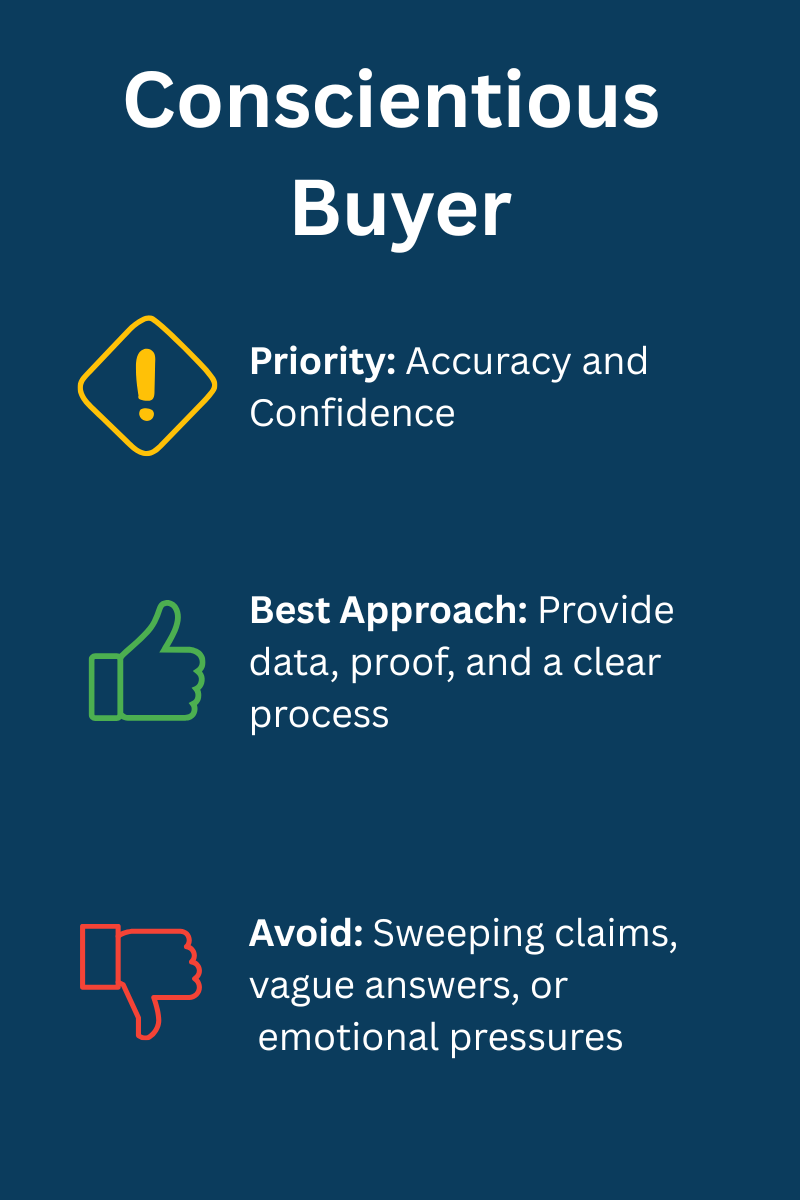
A Conscientious buyer (C-personality Type) is often focused on accuracy, logic, process, and risk reduction. They may ask detailed questions and want evidence before making a decision.
| What they may be thinking | How to respond |
|---|---|
|
“Can you prove this?” |
Bring data, examples, and documentation. |
|
“What could go wrong?” |
Discuss risks honestly and explain how they are managed. |
|
“How exactly does this work?” |
Provide process steps and technical clarity. |
A C-style buyer may appear skeptical, but skepticism can be a sign of engagement. They are testing whether the solution is sound. Give them the substance they need without becoming defensive.
Example: “That is a fair concern. Here is the process we use to prevent that issue, and here is where we can build in a checkpoint before rollout.”
Navigating blended profiles
Most buyers do not fit neatly into one category, just as everyone is a mix of all four DISC styles. A buyer’s DISC personality usually reflects a blend of priorities. One buyer may want fast results and detailed proof. Another may be warm and relationship-oriented but still deeply cautious about risk.
That is why rigid categorization can backfire. DISC is most useful when it helps salespeople stay curious.
| Blended buyer style | What they may need | Sales adjustment |
|---|---|---|
|
D/C |
Results plus proof |
Be concise, but bring strong data and a clear business case. |
|
D/I |
Momentum plus excitement |
Keep energy high and focus on bold outcomes. |
|
I/S |
Relationship plus reassurance |
Build a connection and show how people will be supported. |
|
S/C |
Stability plus accuracy |
Slow down, provide process details, and reduce uncertainty. |
The reality of hybrid buyer styles
Buyer behavior can also shift depending on pressure, role, and context. A normally warm buyer may become more C-like when reviewing a contract. A typically decisive buyer may become more S-like when the decision affects a large team. A technical stakeholder may care about accuracy, while the executive sponsor cares about speed and strategic value.
DISC helps salespeople ask better questions:
- What does this buyer need to feel safe moving forward?
- Are they looking for speed, proof, connection, or reassurance?
- What would make this decision feel risky to them?
- How can I adjust without becoming inauthentic?
This is also where modern sales technology can help. Online buyer behavior, email tone, LinkedIn activity, meeting participation, and response patterns can all provide clues. For example, a buyer who sends short, decisive emails may appreciate a clear executive summary. A buyer who asks for detailed documentation before a call may need more evidence up front.
For more on how DISC relates to psychological comfort and trust, see “Understanding Customer Psychological Needs.“
How to pitch to multiple profiles
Many sales conversations involve more than one buyer. A demo might include an executive sponsor, a department manager, an implementation lead, and a skeptical finance partner. Each person may be listening for something different.
A strong DISC-informed pitch gives each style something they need:
| Stakeholder need | DISC-informed pitch element |
|---|---|
|
Results |
Lead with business outcomes and success metrics. |
|
Energy |
Share the vision, story, and momentum behind the solution. |
|
Stability |
Explain implementation, support, and change management. |
|
Accuracy |
Provide evidence, timelines, specifications, and risk controls. |
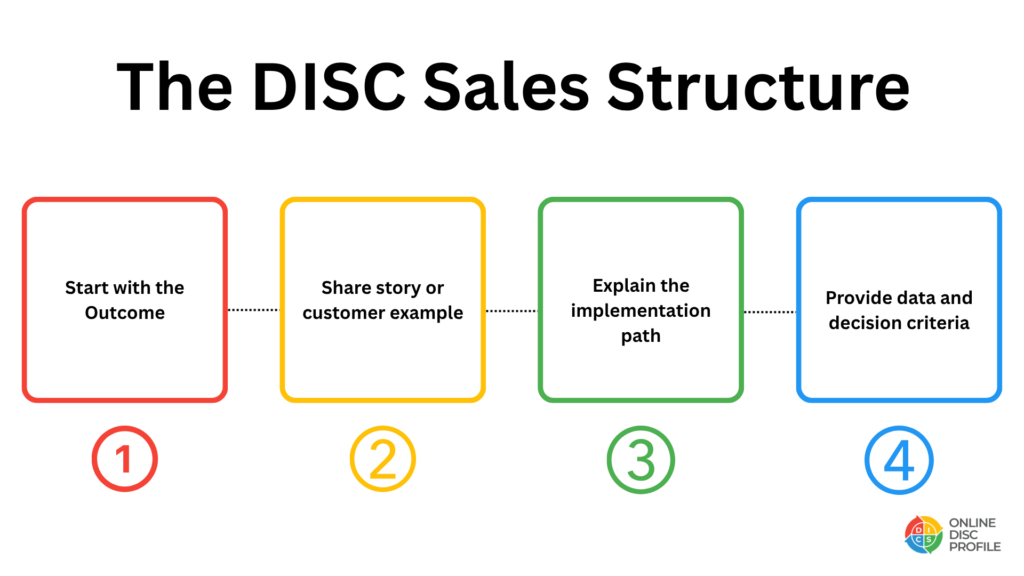
One simple structure is:
- Open with the outcome. This helps D-style buyers engage quickly.
- Share a brief story or customer example. This helps I-style buyers see possibility.
- Explain the implementation path. This reassures S-style buyers.
- Provide data and decision criteria. This supports C-style buyers.
- Close with clear next steps and room for questions.
Expert tip: When presenting to a group, do not only adapt to the loudest person in the room. The most expressive stakeholder may not be the final decision-maker, and the quietest stakeholder may hold the strongest concerns.
Listening is an important part of this process. DISC does not directly measure listening, but it can help you understand how different people communicate what they hear, question, resist, or accept.
Learn more in Does DISC Measure How You Listen?.
Make DISC an ongoing feature of your sales pitch
DISC should not be treated as a one-time workshop or a shortcut to closing deals. The real value comes when sales teams use it consistently: before discovery calls, during demos, in follow-up emails, when managing objections, and when preparing for renewal conversations.
A DISC-informed sales team can:
- Adjust communication based on buyer priorities
- Build trust faster by reducing unnecessary friction
- Recognize when a buyer is uncomfortable or disengaged
- Present information in a way different stakeholders can process
- Avoid overusing the salesperson’s own preferred style
- Improve sales conversations without sounding scripted
This is why DISC belongs inside ongoing sales training, coaching, and team development. Salespeople become more effective when they understand both the buyer and themselves.
For practical communication strategies, explore how to improve communication using DISC styles and the meaning behind DISC personality colors.
Better sales conversations start with better understanding
Understanding buyer behavior with DISC is not about manipulation; it is about making the sales process feel clearer, safer, and more relevant to the person making the decision.
When salespeople learn to recognize different buying priorities, they can adjust their tone, pace, examples, and level of detail. That helps buyers feel understood instead of pressured.
If your sales team wants to apply DISC before, during, and after the sale, explore online DISC training for teams and learn how DISC can become a practical part of your sales process.
Alternatively, fill out the form below to speak with a member of our team!
Connect with our team!
Want to use DISC to improve sales? Our team can help!
"*" indicates required fields