
DISC for TEAMS
Learn How to Improve Team Culture and Communication with DISC

Improve Team Communication with DISC
DISC can leverage individual insights to help teams and organizations improve communication. It offers a wealth of information in group or team-specific reporting, which will help improve internal communication and culture.
We have worked with DISC since 1986 and have seen how a group’s style, motivations, and stressors can be easily identified through its lens. The DISC Group reports will help leaders understand their team, group, or organization’s DISC Personality. Pairing these tools with formalized DISC Training will help build a foundational language everyone can use to promote their needs and learn when and how to adapt to other team members’ behavioral needs.
How DISC Identifies Team Dynamics
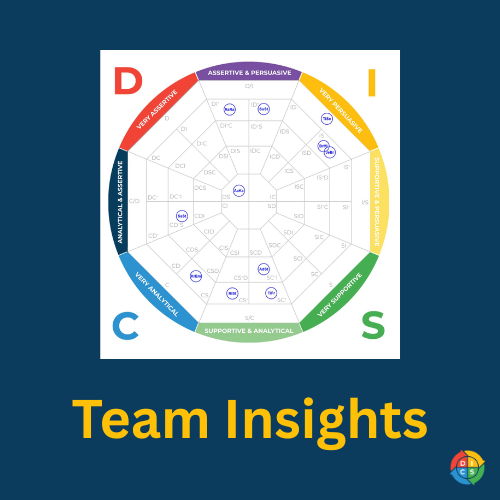
Think back to a time when you started a new job. What was your first impression of your new team’s atmosphere and culture?
Was it quiet, like a library? Or was it energetic and lively? Perhaps you didn’t take notice at first, but you recognized that you meshed with your team over time. Alternatively, maybe there were issues you felt could never be resolved because you felt so different from everyone on the team.
As the saying goes, a picture is worth a thousand words.
DISC offers a picture that helps teams and organizations understand the culture of a group.
The same DISC map that is used for individuals can be repurposed for groups. Our DISC assessments provide aggregated reports that help teams understand the culture.
DISC can tell a story about a team that is great at offering dynamic solutions, but has poor follow-through or misses details. It can explain why some teams are always talking, while others hardly speak a word to each other. The insights work for both individuals and groups because the model’s simplicity allows for a dual representation.
Digging deeper into the data, you can leverage the insights to understand why conflict might arise on a team when two conflicting behaviors are present.
For example, DISC can help teams understand which members prefer to make decisions quickly, with little planning or consideration of all the risks. This behavioral tendency can cause rifts on teams when team members are at odds with the team leader in terms of their behavioral tendency or when groups are empowered to make their own decisions, and they have different priorities when it comes to making a decision.
DISC Basic Behavioral Tendencies Report
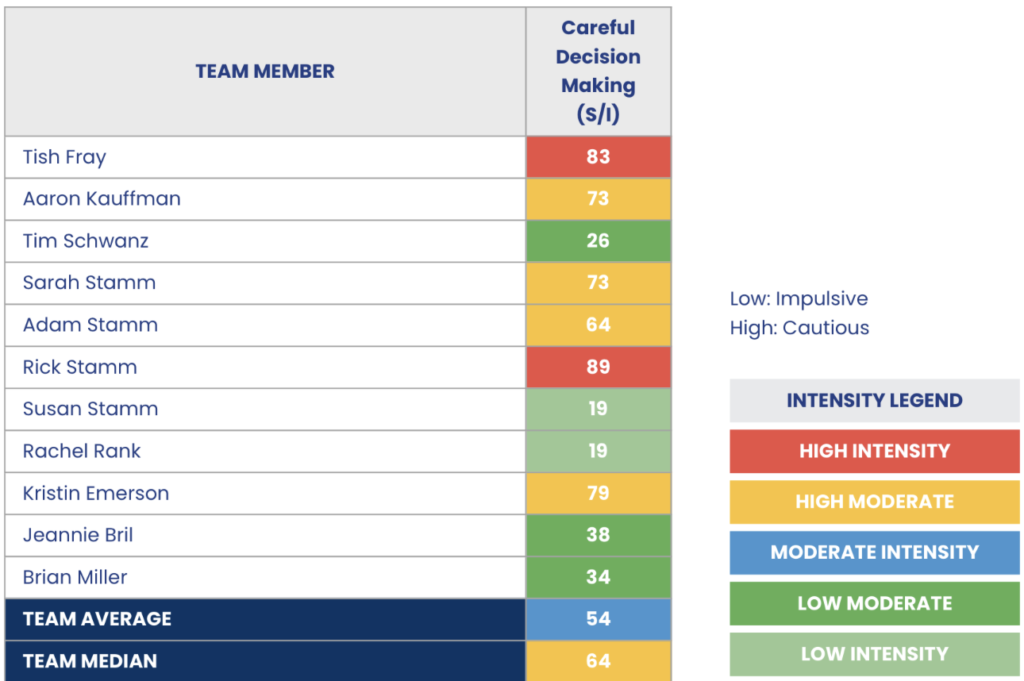
The DISC Basic team report provides a detailed graph of each individual team members scores for the behaviors that are scored during the assessment process. The color coding can provide teams an easy way to find areas that might cause conflict when there isn’t a good mix of styles or an extreme sorting of styles.
Applying DISC Results in the Workplace
There are three distinct ways to leverage DISC insights in the workplace to improve how teams operate: Leadership Development, Team Development, and Organizational Development.
Leadership Development
One of the more interesting aspects of teamwork is the relationship between the team and its leader. We have worked with many teams where the leader and the team meshed really well. To no surprise, we found that the team’s behavioral styles matched the leader’s DISC Profile.
Alternatively, when there were dysfunctions, we found wide gaps between the leader’s and the team’s behavioral styles.
Of course, we have also worked with teams where there was a wide behavioral gap between the team and the leader’s style, and little to no dysfunction. On these teams, there was a singular reason why they didn’t fall into dysfunction: self-awareness.
To help leaders develop more self-awareness around how their behaviors impact the team around them, we utilized two tools:
This two-pronged approach allows leaders to receive anonymous feedback on how they are perceived, and, using the DISC Leadership report, we can showcase how their behavioral style influences their decisions and the environment on their team. The results of this type of program have shown to reduce employee turnover, resolve team tension and conflict, while also helping leaders improve how they communicate with their team.
About 360 Feedback and Performance Reviews...
360 Degree Feedback assessments are often used for performance reviews. We don’t believe this is a good use of your time or money. If you position a 360 Degree Feedback process as a learning opportunity (and mean it), you will find it more effective and offer more insights.
Team Development
Building a collaborative culture requires going from a one-time event to an ongoing process and discussion. DISC offers a language that helps explain stressors and motivational preferences immediately.
When teams go through a facilitated group workshop, they will not only have a chance to bond during the event, but also gain a tool and language they can use throughout their workday.
Here are two ways to get started with using DISC for team development:
- 2-Hour Introductory Team DISC Workshop
- DISC Basic Full Report (one per individual team member)
- DISC Basic Group Report
Organizational Development
The strategy for building a collaborative organization is very similar to building a collaborative team, except for one area: scale.
When focusing on creating a rich organizational culture, you need to go beyond just having team leaders or individual teams learn and use the DISC language to having the whole organization leverage DISC insights throughout their workday. The tools are similar, except there are a few additional items that will help:
- DISC Admin Platform (manage and issue assessments)
- DISC Certification (become certified to teach DISC!)
Validity Reliability and Frequently Asked Questions
DISC theory was first written about in 1928. That’s almost 100 years of modeling behavior in a simple format that isn’t overly simplistic. Today, the assessment process goes through a rigorous research process.
Reliability and Validity
DISC Basic assessments are all researched for reliability and validity. They undergo a 10,000-person research study conducted by a third-party organization unaffiliated with our organization to ensure accuracy and quality. Assessments Standards Institute (ASI) validates many assessment products each year, and we are proud to work with them to ensure we are bringing the best and most accurate products to our customers.
Frequently Asked Questions (FAQ)
We help thousands of teams every year use DISC. Here are some of the most frequent questions we recieve.
Reliability seeks to understand whether, if someone takes an assessment multiple times, they will get the same result. Our DISC Research has shown that these tools are highly reliable.
When using DISC with teams, you can trust that the results you receive won’t drastically change if someone takes the assessment again.
Miscommunication is one of the greatest issues in any workplace. DISC primarily focuses on helping people communicate better by understanding their motivations and stressors. When we communicate, these needs merge into everything we discuss. With DISC, we can develop greater self-awareness of these needs and start to see how they manifest as we work together as a team.
Compared to tools like StrengthsFinder or MBTI, DISC is primarily used for workplace development and for team and organization development.
Like any tool, DISC is only as good as its implementation plan.
We strongly suggest using DISC within a facilitated experience. When you work with a facilitator, they can ensure the insights are learned. Additionally, they can bring other topic areas like sales, management, productivity, or leadership curriculum into the DISC workshop to expand the experience into a holistic program.
Looking to use DISC Team Reports?
Are you interested in using DISC for team development or to improve group culture on your teams / organization? Connect with our team and let us know what you are looking to accomplish! We look forward to hearing from you.
"*" indicates required fields