
The meaning behind DISC personality colors

Kristin Emerson
Training Director
Kristin worked as a professor at NC State prior to working in Talent Development. Since leaving the world of academia, Kristin has worked with organizations both large and small helping to improve team culture, emotional intelligence, and leadership development.
DISC is often recognized not by letters, but by four simple colors: Red, Yellow, Green, and Blue.
These colors are not just visual shortcuts. They help people quickly understand behavioral styles, remember key tendencies, and apply insights in real situations. While everyone is a blend of all four, most people have one or two dominant colors that shape how they communicate, make decisions, and respond under pressure.
This guide focuses on what those colors represent and how to interpret them at a glance.
Table of Contents
- Why does DISC use colors?
- The Red personality (Dominance)
- The Yellow personality (Influence)
- The Green personality (Steadiness)
- The Blue personality (Conscientiousness)
- Can you be more than one color?
- Find your DISC color
Why does DISC use colors?
Colors make DISC easier to understand and apply, especially for beginners.
Instead of remembering abstract labels, people can quickly associate behaviors with something visual and intuitive.
Here’s why the color model works:
- Memorability: Colors are easier to recall than technical terms
- Speed: You can identify patterns quickly in yourself and others
- Emotional association: Colors naturally connect to energy, pace, and tone
- Accessibility: Works across cultures and experience levels
In practice, colors act as a “mental shortcut” for recognizing behavior in real time.
If you’re newer to DISC, you may want to start with a broader overview of the model before diving deeper into each style.
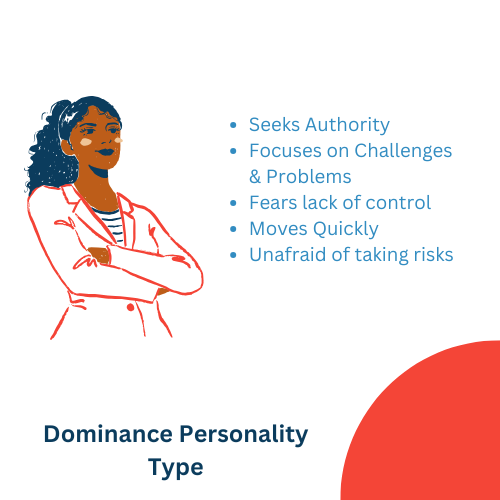
The Red personality (Dominance)
Definition
Red represents a direct, results-oriented style focused on action and control.
At a glance
- Fast-paced and decisive
- Focused on outcomes and efficiency
- Comfortable taking charge
- Prefers challenges over routine
Common roles (remember, any style can be successful in any role; however, each style often gravitates toward specific roles)
- Leaders and executives
- Entrepreneurs
- Project drivers and decision-makers
Learn more about this style: Understanding the Dominance DISC type
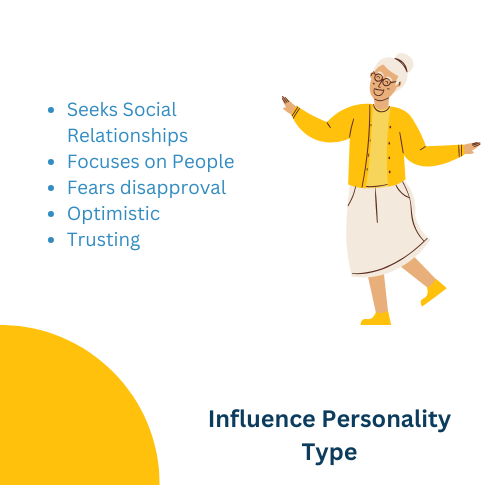
The Yellow personality (Influence)
Definition
Yellow represents an outgoing, people-focused style centered on connection and enthusiasm.
At a glance
- Energetic and expressive
- Persuasive and optimistic
- Relationship-driven
- Thrives in social environments
Common roles
- Sales and business development
- Marketing and communications
- Facilitators and team motivators
Learn more: Learn the I Personality Type
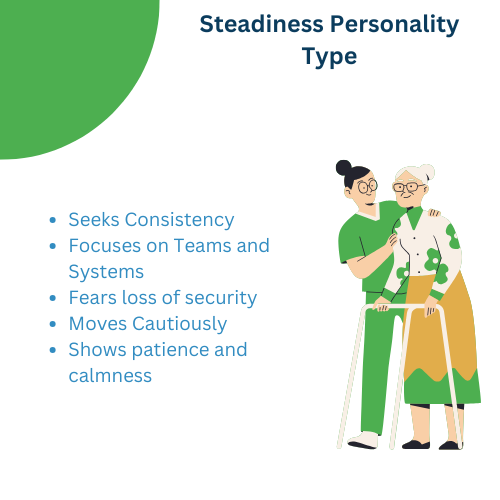
The Green personality (Steadiness)
Definition
Green represents a calm, supportive style focused on stability and collaboration.
At a glance
- Patient and dependable
- Loyal and team-oriented
- Prefers consistency over rapid change
- Strong listener
Common roles
- HR and people support roles
- Operations and coordination
- Caregiving and service roles
Learn more: Learn About the S Personality Type
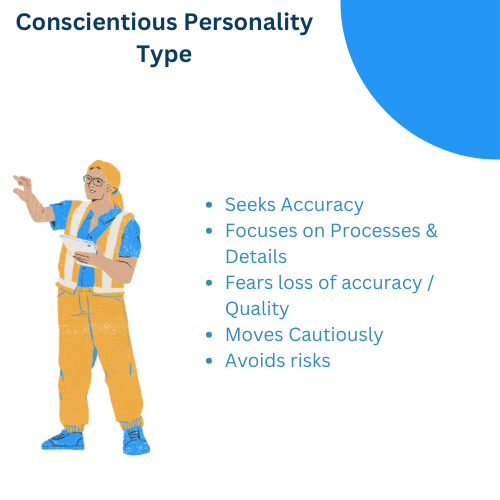
The Blue personality (Conscientiousness)
Definition
Blue represents an analytical, detail-oriented style focused on accuracy and quality.
At a glance
- Logical and systematic
- Detail-focused
- Values structure and precision
- Prefers data over intuition
Common roles
- Analysts and engineers
- Finance and compliance
- Research and technical specialists
Learn more: Learn the C Personality Type
Can you be more than one color?
Yes. In fact, almost everyone is.
Very few people are purely one color. Most are blends, with two or even three colors influencing how they show up.
For example:
- Red + Yellow: Fast-paced and persuasive
- Yellow + Green: Warm and relationship-driven
- Blue + Green: Thoughtful and steady
- Red + Blue: Results-focused but analytical
You can think of DISC like mixing paint. The four primary colors combine to create a wide range of “shades” or styles. This is where DISC becomes more useful and more accurate.
In fact, the person who theorized DISC theory (William Moulton Marston) used this exact analogy saying that when you viewed a person’s personality could be viewed as a color wheel.
If you want to go deeper into combinations, explore:
Why this matters in real life
Understanding DISC colors helps you:
- Recognize how others prefer to communicate
- Adjust your tone, pace, and approach
- Avoid common misunderstandings
- Work more effectively across different styles
For example:
- A Red may want you to get to the point
- A Yellow may want engagement and energy
- A Green may want time and reassurance
- A Blue may want details and clarity
If you’re applying DISC in teams, this becomes even more powerful when combined with tools like:
- How to improve communication using DISC styles
- Understanding the needs of DISC types in social settings
- Understanding the needs of DISC types for learning
DISC colors vs other personality color systems
Not all color-based personality models are the same.
DISC colors are sometimes confused with:
- Taylor Hartman’s Color Code
- Myers-Briggs frameworks
- CliftonStrengths
Each model uses color differently.
If you’re comparing models, this resources can help:
Find your DISC color
The fastest way to understand your own style is to take a DISC assessment.
Once you know your primary color and your blend, you can:
- Communicate more effectively
- Understand your stress patterns
- Adapt to others with intention
Start here:
Take a DISC personality assessment and discover your color blend
Final thought
DISC colors are not labels; they are tools. They give you a simple, visual way to understand complex human behavior and apply that insight in real time.