AI in the workplace: What your employees’ AI usage says about their personalities

Adam Stamm
Managing Partner: Online DISC Profile
Adam was first certified in DISC in 2018. Over the years, he has developed new DISC Products and other personality-based tools. He is a Managing Partner at Online DISC Profile, Chapter President of the Association of Talent Development Greater Philadelphia Chapter, and lives in Philadelphia, PA (USA).
Over a third of Americans (35%) use AI at least weekly, including tools such as ChatGPT, AI Mode on Google, and Midjourney.
This usage continues to soar around the world, helping improve ways of working and speed up processes, but what does how you use AI at work say about your personality?
We have surveyed over 4,000 people to find out about their workplace AI habits, whether they fear for their jobs, and just how often they use these tools.
Exploring the insights, I share how these behaviors correlate with your DISC personality type and speak with industrial/organizational psychologist Jeannie Bril, who specializes in team development, to understand how workplace AI use can impact psychological well-being.
How often employees are using AI at work
We asked 4,332 people worldwide about their AI usage at work, with regard to how often they use it, whether they think AI will take their jobs, and whether they feel it helps or hinders them.
Key stats:
- Most people are comfortable (41%) or somewhat comfortable (35%) using AI at work. But despite this, many aren’t using it often (25%), or at all (18%)
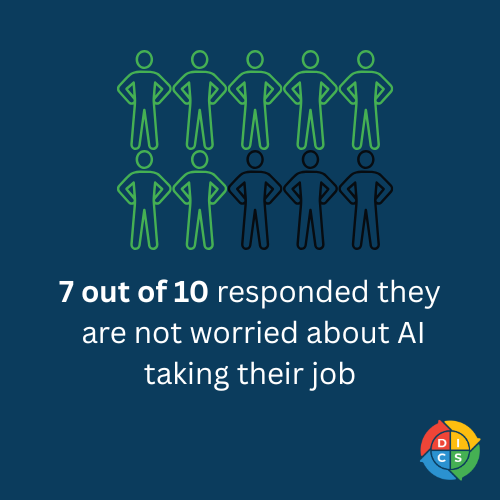
- Seven out of ten people (71%) feel secure in their jobs and are not worried at all about AI taking them
- Just under half (46%) believe that AI helps them at work, but 50% say this depends on what they are doing
More than four in ten people (43%) are choosing to rarely, or not at all, use AI at work, which could suggest a few things. Perhaps AI restrictions are in place at their work, and therefore limiting usage, so despite being comfortable, they aren’t able to use AI often. Or perhaps they are not actually aware they are using AI, with it being integrated so seamlessly into most tools in the workplace (like Grammarly, for example), and have just assumed their AI usage is small.
There is plenty of media coverage circulating about the potential jobs at risk of being replaced by AI, but our survey data shows that an overwhelming 71% feel very secure and that AI won’t take their jobs.
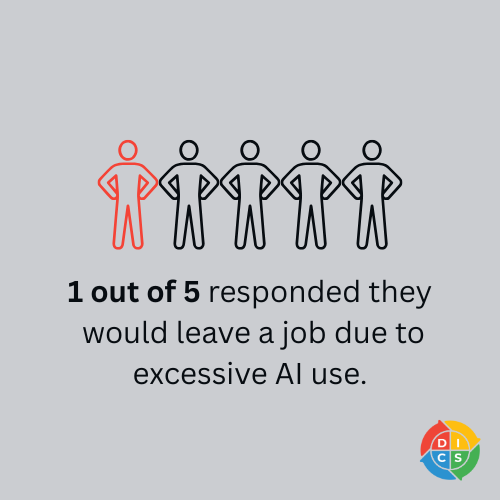
What is interesting is that despite the security and high AI usage at work, more than one in five (22%) employees say that they are very likely, likely, or somewhat likely to leave a job due to excessive AI use.
As the number of AI tools increases and their capabilities become more clever, it will no doubt cause some people to worry about how AI-centric our world is becoming.
In a YouGov survey from 2025, it showed that 44% of Americans are skeptical about these AI advances, compared to 36% the year before. But, despite these figures, the results from our survey still show an overall comfort level around these tools, with 41% fine to use them at work.
Stressed employees are using AI more often

In addition to our main survey, we asked an extra 740 people about stress at work, how it impacts their AI usage, and whether it prompts them to use it more when feeling stressed.
Key stats:
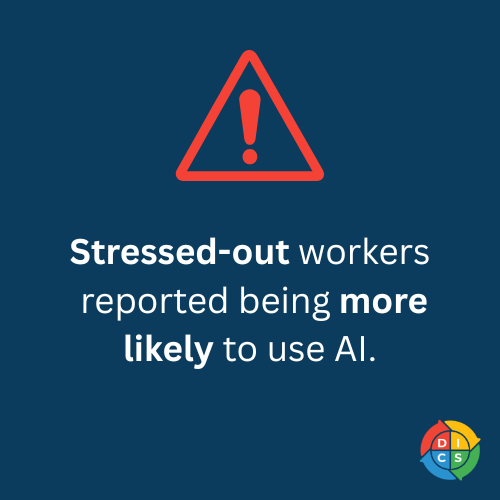
- Nearly a third (29%) of US employees often (very often and often) feel stressed at work
- Those who are often stressed at work are more likely to use AI than not, with nearly a third of people (32%) often using it, and only 16% never using it
- Those who say they never feel stress at work are rarely (25%) or never (26%) using AI
This presents a link between AI use and higher stress levels, but it could also indicate that employees are using AI tools to help them manage their stress and simplify tasks.
Jeannie Bril, Organizational Psychologist, believes that increased use of AI tools could be a coping strategy where stress has led to burnout:

"When workloads exceed an employee’s capacity, individuals often engage in coping strategies to preserve performance, and AI can become one such strategy."
“It’s often thought that AI can help employees keep pace, reduce cognitive effort, or meet expectations under pressure. In this sense, relying on AI may reflect work intensification rather than productivity gains.
Often, managers are unaware of the day-to-day tasks that go into routine job duties. Sharing how a new project may impact an employee’s existing commitments can help set shared expectations between employee and manager, thereby reducing stress, miscommunication, and anxiety.”
Can using AI at work help with stress and burnout?
Reports show that employee burnout costs U.S. companies between $4,000 and $21,000 per employee each year, highlighting the need for managers to recognize when their employees are feeling the strain and look for ways to help with this, including the use of AI tools.
According to a survey from February 2025 of 200 IT professionals, workplaces using AI tools saw a 25% drop in emotional exhaustion.
Jeannie notes that it’s hard to know if additional stress is caused by AI or whether it’s helping: “In general, the world has grown increasingly stressed over the past 20 years. Gallup has measured this trend for decades and found a 7% increase in overall stress from 2006 to 2024. While these two points are strongly correlated, it’s not entirely certain that AI is the cause of workplace stress.
The goal of AI is to lighten the load of daily work tasks that cause stress (e.g., data crunching, menial tasks, brainstorming). Case studies are emerging that show the effectiveness of AI agents in helping small teams grow businesses to over $1M in annual recurring revenue, and we may continue to see more of these case studies in other areas outside of making more money and helping individuals achieve more of their personal goals.”
Tools that can help with workloads
- Grammarly – this is a browser extension that can help with spell checking on any app or website
- Fathom – a tool that can be invited into virtual meetings and help to transcribe the call, summarize the key points, and takeaways
- Asana – a project management tool that can identify project risks and workflow blockers
The link between psychological well-being and AI usage
Jeannie notes that from an industrial organizational (I/O) psychology perspective, an individual’s decision to use or avoid AI can be linked to psychological well-being, as it could be associated with one’s identity, competence, and perceived value at work.
She says that well-being at work is supported when employees experience three factors (Deci & Ryan, 2000):
- Autonomy
- Competence
- Relatedness
“When AI use feels forced, monitored, or indirectly judged by peers or managers, it can undermine these three needs, regardless of whether the employee adopts or resists the technology. Some employees may worry that using AI indicates they have a lower ability in an assigned task, while simultaneously fearing that refusing AI shows they are unwilling to try new technology.”
Jeannie Bril
Jeannie states that this form of identity threat and impression management anxiety is well documented in I/O psychology research and is associated with increased stress, rumination, and reduced engagement (Leary & Kowalski, 1990; Petriglieri, 2011).
Rand Fishkin, a well-known thought leader in the marketing and business development space, predicts that there will be greater corporate pressure to adopt AI in 2026, which has the potential to affect a person’s psychological well-being.
Jeannie notes that if a person feels forced to use AI, it may challenge their identity. She says: “For example, individuals in creative jobs may experience negative impacts on their psychological well-being if they are forced to use AI tools at work because they previously had the freedom to choose how to do their jobs.”
And this isn’t a phenomenon specific only to AI. She adds that this is also true with non-AI tools: “In his book, Thinking Fast and Slow, Nobel Prize winner Daniel Kahneman found this to be true when Army recruiters were forced to use algorithmic questioning to determine leadership readiness. They reported lower job satisfaction than when they had the freedom to conduct readiness interviews as they saw fit. By being forced to choose candidates based on an algorithmic score, they felt like “machines”.”
Personality traits and AI usage
Whether someone regularly uses AI at work or would rather steer clear of it altogether can give us an insight into their personality traits.
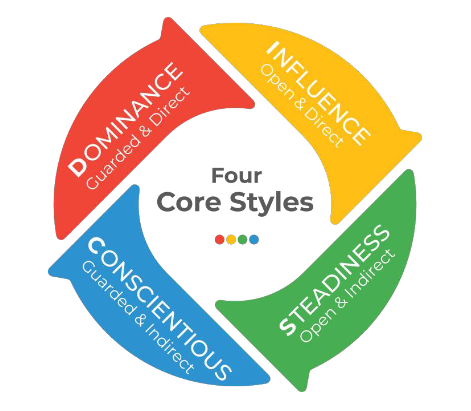
Our behavioral and psychological needs could be a determining factor in the ‘why’ behind our use of AI, and DISC offers an easy decoder to understand these needs.
Employees who are comfortable using AI at work
This style prioritizes efficiency to fulfill a psychological need for working with urgency and completing tasks. AI’s speed is unparalleled compared to that of humans, and it can be a useful tool for those who are D-type.
They may find AI fun to use compared to other high-tech tools, certainly with LLMs, as you can have conversations with them. The I-type is energized by enthusiasm along with optimism, and regardless of how you interact with AI, the response is always cheerful and full of possibilities.
The Steadiness style prefers working in systems and processes. AI makes a perfect process-oriented teammate because you can plug datasets, projects, or questions right into it.
The C-Style works within a need for a high degree of accuracy. AI is an incredible researcher when used with specific data sets. Human errors can be nullified with an AI companion.
“When workloads exceed an employee’s capacity, individuals often engage in coping strategies to preserve performance, and AI can become one such strategy.”
Jeannie Bril
Employees who are not comfortable using AI at work
D-type personality
This type of personality has a high need for control, and it’s possible that they don’t trust AI to do the job in the way they prefer to work.
I-type personality
People with the I-type have a high need for social approval. If their workspace is overly disapproving of AI use, it’s very possible they will avoid using it to stay in good social graces with their peers.
S-type personality
The Steadiness personality type places a high emphasis on others’ needs. AI might offer a better option for content optimization, creation, or ideation. However, if AI use means someone on the team might get let go, they may prefer not to use the tool.
C-type personality
What is the C-type’s worst fear? Being inaccurate or wrong. AI is known to hallucinate – it’s part of its programming to conceptualize, but this could cause people who are conscientious types to avoid using AI if they constantly question the accuracy of what’s created.
Businesses need to be inclusive with their use of AI
In every business, you will have employees who want to use AI and those who don’t, and managers will need to be respectful of people’s choices and communicate to understand their preferences.
These preferences can sometimes be founded on psychological needs. For example, if someone is a D-type and has a strong need for control, managers who understand this can then communicate that they understand that using AI could cause them stress, as the tool will be taking away some of their control, and help them manage their usage to reduce this stress.
When we use DISC to work with managers, we often emphasize the need to personalize feedback, direction, and communication to meet the listener’s psychological needs. All of us will be more effective communicators when we consider the needs, fears, and stressors of the person we are talking or working with.
This is called the platinum rule: “Treat others how they want to be treated.”
Not only should businesses and managers be considering the needs of their employees, but they should also be transparent about their AI usage as a company. For example, if you use an automated note taker, like Fathom, in meetings, this needs to be communicated to all employees, as some people might not be comfortable with an AI tool recording them.
Use DISC to support your employees using AI in the workplace
The key takeaways from our survey highlight that while the majority of people are comfortable using AI at work, it is not something that people do regularly.
Those who are feeling stressed at work are more likely to use AI, suggesting a correlation between either using AI to manage stress or AI being the cause.
Whether your employees are using AI or not, managers must be able to understand their employees’ personality traits and needs that could lead to reasons for or against their AI usage, and using DISC can be a helpful tool for this.
A person who is C-type and fears being wrong might struggle to use AI that can regularly make mistakes. If managers have this understanding, they can work with them to ensure that any time they feel uncomfortable using an AI tool implemented at work, they are free to express this and work on a solution that suits both the employer and employee.
DISC assessments and training can be done at any workplace, and we offer a free DISC leadership assessment for managers wanting to learn how understanding their employees’ traits will help them improve their employees’ well-being and understand any concerns around topics such as AI usage.
About Jeannie Bril
Jeannie Bril is an industrial/organizational psychologist, facilitator, and coach who specializes in personality assessments and team development–bringing decades of experience in leadership training, talent management, employee engagement research, and learning & development.